

Choose your study path that is tailored to your preferences!
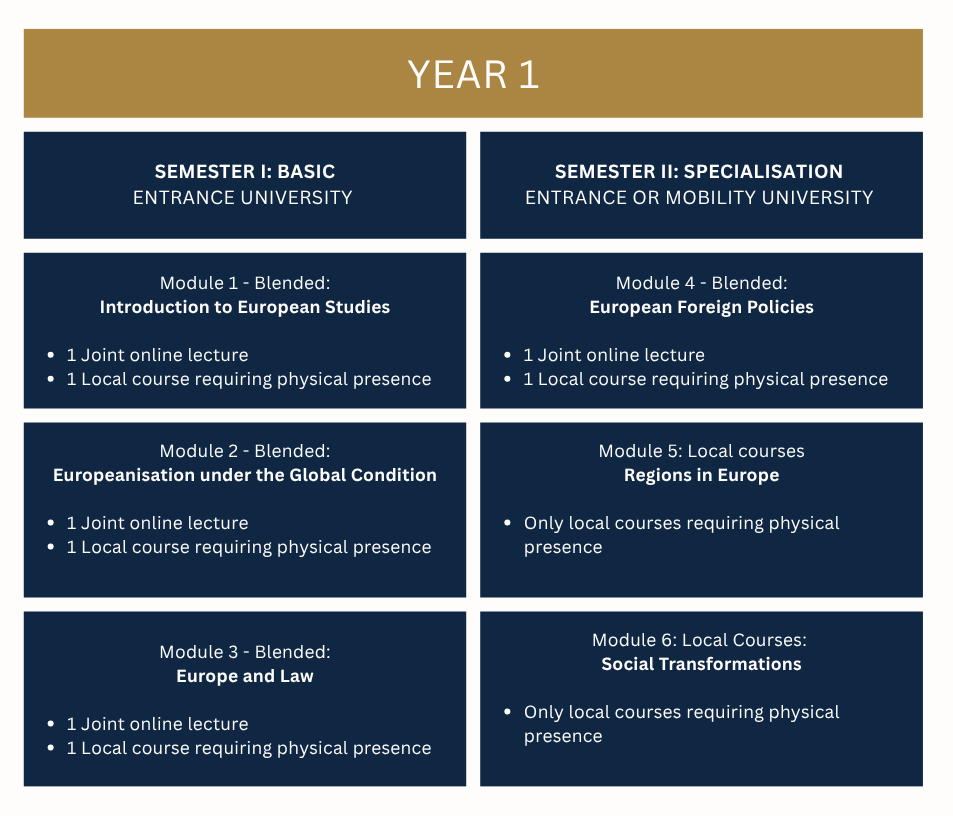
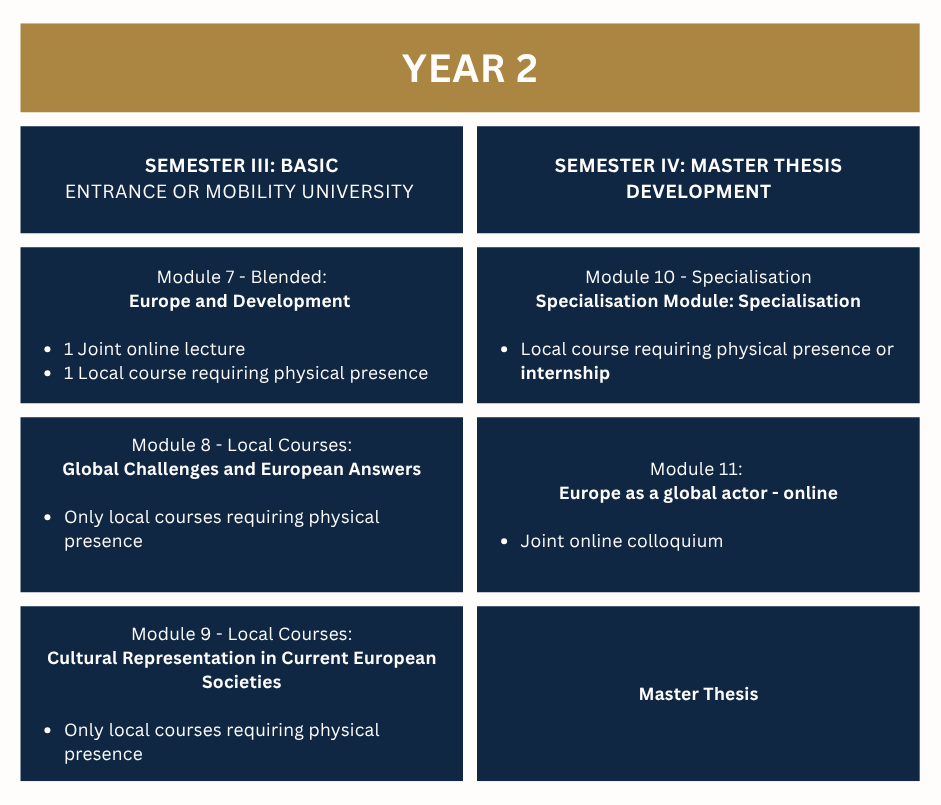
You can create your individual programme by choosing your study locations and specialisations. The programme is structured into 11 different modules divided into two types:
1. Joint blended modules
Offered collaboratively by all partner institutions. Students attend joint classes, with lecturers from all four partner universities teaching in their areas of expertise. Each module includes:
- one jointly offered online course and
- one on-site local course taught by local lecturers.
2. Specialisation modules
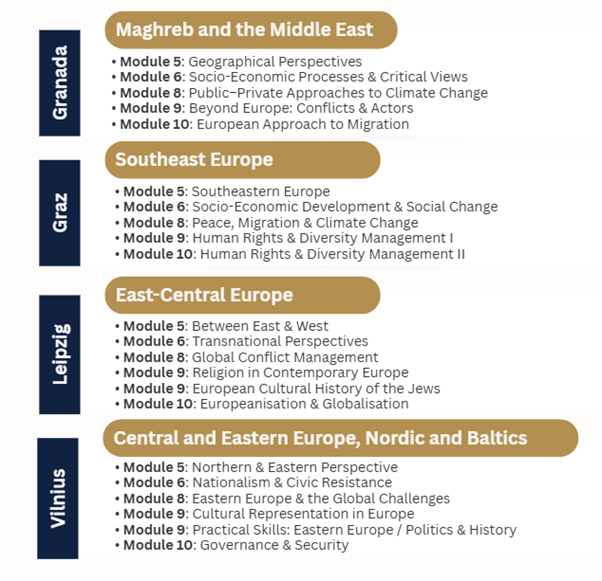
Managed individually by each study location. They encourage physical mobility by highlighting each university’s geographic and expert focus, within a shared thematic framework. These modules allow students to prepare for their theses in a subject-specific way.
Specialisations and regional focus of partner universities
Module overview
The programme is structured into 11 modules distributed across four semesters.
Virtual & physical mobility options
Students usually spend a mobility semester (with the minimum of 30 ECTS) at one of the partner universities other than the entrance university. Students might also choose, according to their own preference and availability, to remain onsite, at their entrance university only, and generate mobility ECTS virtually through joint online lectures.
Mobility features:
- At least 30 ECTS at another university, virtually and/or physically
- Virtual mobility is included in six out of 20+ courses through joint online lectures
- Physical mobility is strongly recommended, with Erasmus funding if studying at a partner university
Internship
Students may be allowed to replace one local course with an internship. The rules for this replacement and internship requirements depend on the regulations of your entrance university. For more information, please check the student handbook.
Students may complete:
- an external internship outside the universities, or
- a research internship at one of the partner universities
Opportunities
Students can participate in numerous European Studies research projects at all study locations. Alternatively, they may organise their own internship to complement academic knowledge with practical skills.
Support, Coordination & Recognition
- From the start of the programme, students can contact local coordinators or the programme coordinator in Leipzig for advice on internships, scholarships, and part-time jobs.
- All study locations have strong links with companies, organisations, and media related to European Studies.
- The Arqus Internship Portal offers internship announcements across all Arqus universities.