
Type: Arqus, Arqus European University Alliance, Artificial Intelligence
Format: Online, Workshop
Open to: Academics & researchers, Admin. Staff, Master's students, PhD Students, Teachers
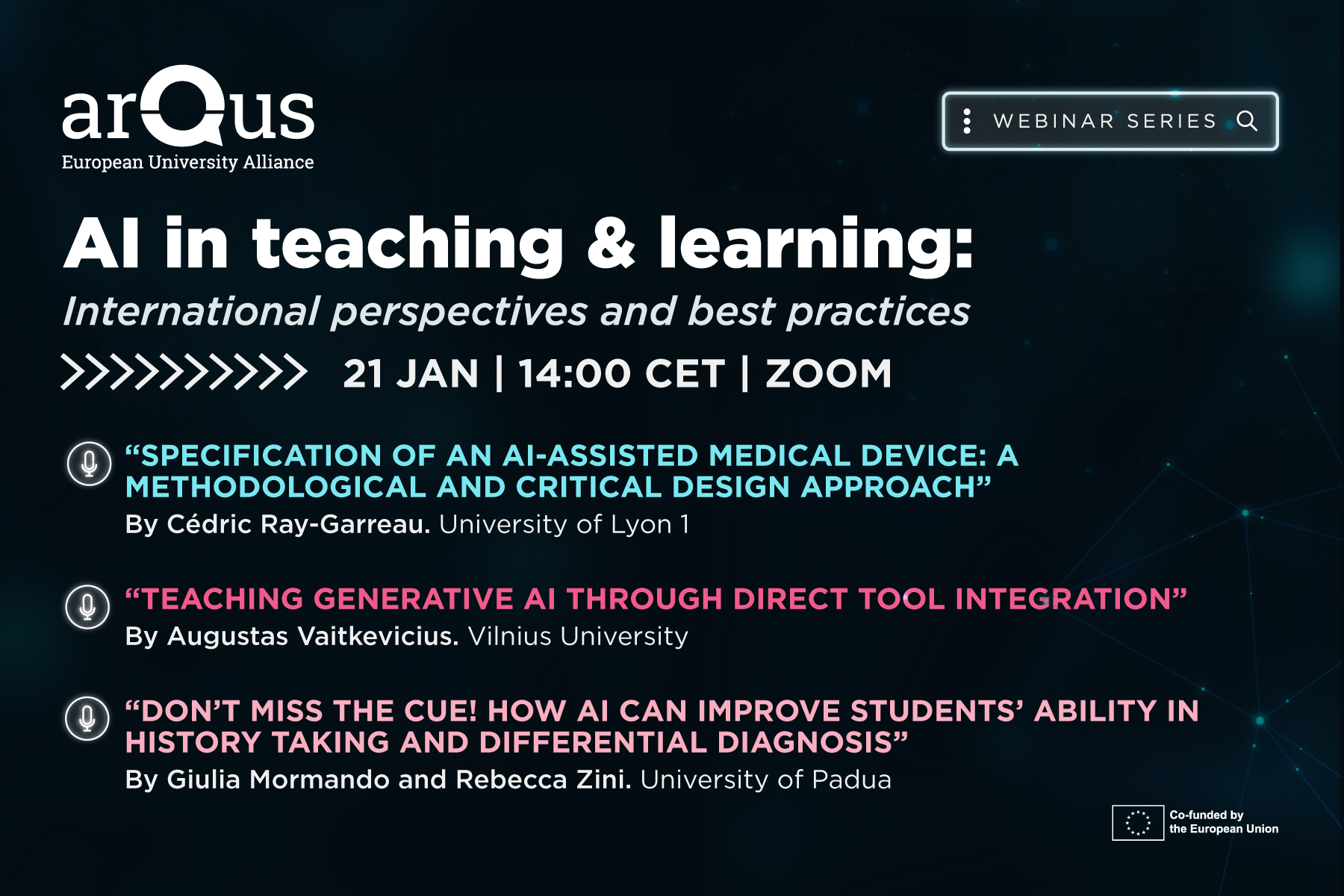
Artificial intelligence is changing university teaching – but how can it be used effectively? In this series of online workshops, experts from Arqus universities share their experiences and challenges in using AI in teaching. The fifth session of the series will take place on 21 January at 14:00 CET on Zoom.
The “AI in Teaching & Learning: International Perspectives and Best Practices” workshops consist of 90-minute online sessions, in which experts from European universities will share insights into the use of AI-supported applications and present best practices. This workshop series will aim to explore and discuss both the opportunities and challenges that AI brings to the future of teaching.
Specification of an AI-assisted medical device: A methodological and critical design approach, by Cédric Ray-Garreau (University of Lyon 1)
This talk reports on a third-year biomedical engineering project focused on the specification of an innovative AI-assisted medical device that aims to produce structured requirements document based on clinical needs, functional analysis, and technical constraints.
During the session, the speaker will focus on the critical use of generative artificial intelligence tools, including their limitations, ethical implications, and environmental impact in the design process.
Teaching generative AI through direct tool integration, by Augustas Vaitkevičius (Vilnius University).
During this workshop, the speaker will present a teaching initiative in which students interact with generative AI through structured programmatic access using Google Gemini AI Studio and Ollama.
The talk will highlight how AI tools are connected, configured, and controlled, and how this initiative supports technical literacy, critical thinking, and responsible use beyond chat-based interfaces.
Don’t miss the cue! How AI can improve students’ ability in history taking and differential diagnosis, by Giulia Mormando and Rebecca Zini (University of Padua)
In this workshop, the speakers will explore the use of AI to create training tools. They will specifically focus on how generative AI can be used to improve students’ skills in history taking and differential diagnosis when confronted with thoracic pain.
During the workshop, they will debate the pros and cons of bot-human interaction when training medical examination skills, and explore some of the best resources available for AI beginners
About the speakers
Cédric Ray-Garreau is an associate Professor (HDR) at the University of Lyon 1, he conducts research in biomedical instrumentation, imaging and AI for health.
He has authored 46 peer-reviewed publications, supervised 13 PhD theses and coordinated several funded projects. Currently, he holds leadership roles in educational R&D and institutional innovation, and actively contributes to research training and knowledge dissemination.
Augustas Vaitkevičius is a physicist and lecturer at Vilnius University, where he teaches computer literacy, focusing on programming and AI literacy for physicists, combining hands-on technical skills with critical reflection on AI tools, ethics, and academic practice.
His teaching emphasizes practical use, transparency, and student autonomy.
Giulia Mormando is an emergency medicine consultant, PhD, and researcher at the Department of Medicine (DIMED), at the University of Padua, where she is responsible of the project for training through simulation of the Emergency Medicine Residency Program.
She is fully trained as a trainer and facilitator in simulation. Currently, she serves as Secretary of the Italian Society for Simulation in Medicine (SIMMED) and collaborates with several national and international simulation centers.
Rebecca Zini graduated from the University of Padua in 2019. In 2021, she began her training as an A & E resident, joining the medical simulation faculty in her second year.
Her field of interest includes AI-facilitated medical simulation, CRM and non-technichal skills training.
