Learn about the experience of Giovanni Parente in two transformative Arqus summer schools
|
20 Feb 2026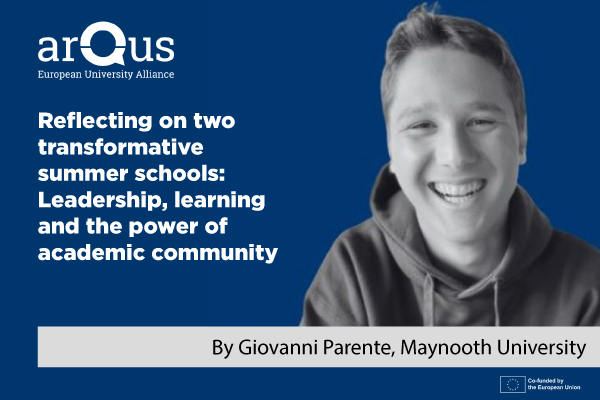
|
20 Feb 2026Reflecting on two transformative summer schools: Leadership, learning and the power of academic community
Author: Dr Giovanni Parente, Maynooth University
Last July, I had the privilege of participating in two remarkable summer schools organised through the Arqus Alliance at the University of Minho. As a recent PhD graduate from Maynooth University, these experiences could not have come at a better time. They offered exactly what I needed: fresh perspectives on teaching in an AI-enhanced world and practical guidance for navigating academic careers.
Examining the future of teaching in Ofir
The first summer school was held in the coastal town of Ofir in the North of Portugal and focused on the “Active Learning in Action: Engaging Students Through AI”. As someone who has taught across remarkably diverse contexts, from military academies to traditional universities, I was curious about how these new technologies might enhance what I was already doing.
Professor Diana Mesquita’s approach immediately impressed me. Rather than presenting AI as a silver bullet solution, she framed it as one tool among many for creating more engaging learning experiences. Her sessions on the TPACK framework examined the intersection of Technology, Pedagogy, and Content Knowledge and, thus, provided a structured way to think about integrating AI meaningfully rather than superficially.
The hands-on nature of the programme was its greatest strength. Instead of just talking about active learning, we were experiencing it. Group projects, peer feedback sessions, and collaborative problem-solving weren’t just pedagogical techniques being demonstrated; they were creating genuine learning moments for all of us.
The AI components were fascinating but never overwhelming. Professor David Smith’s sessions on practical applications showed us tools that could genuinely enhance student engagement without replacing the human elements that make teaching meaningful. We explored how AI might help create more personalised assessments, generate discussion prompts that encourage critical thinking, or provide instant feedback on student work. Overall, the focus remained on creating meaningful learning experiences with AI serving as a carefully deployed assistant.
Refining my leadership voice in Braga
The following week, I moved from Ofir to Braga for the second Arqus Summer School that focused on research leadership and career development.
The sessions led by Professor Sandra Schmid from the Chan Zuckerberg Biohub were refreshingly practical reflections on the principles of research leadership. She spoke about the realities of building and managing research teams, the challenges of fostering innovation while maintaining focus, and the delicate balance between supporting others and advancing your own career. Coming from someone who has led at the highest levels of scientific research, her insights possessed a great motivational component. Additionally, what really resonated with me was her emphasis on creating positive research cultures. The collaborative atmosphere she described was not just an ideal case but a practical necessity for producing meaningful scholarship.
Dr Yasmin Dolak-Struss’s sessions on self-management proved equally transformative. Reflecting on how to manage time and energy effectively while maintaining a good work-life balance was as useful as her frameworks for prioritisation and delegation, which offered concrete tools.
Overall, what made this leadership Summer School especially valuable was how it built upon the pedagogical insights from the previous week. The communication skills and team management principles Professor Schmid and Dr Dolak-Struss discussed were directly connected to the active learning approaches I had just explored in the prior week in Ofir. In this vein, it became very vivid how effective teaching and effective research leadership share many fundamental principles: creating inclusive environments, fostering collaboration, and empowering others to reach their potential.
The Arqus difference
Over the last two academic years, I have participated in various Arqus initiatives, from Wroclaw to Padua, from Ofir to Braga. These were not simply training programmes delivered by individual experts; they were community-building exercises that brought together educators and researchers from across the Alliance’s diverse academic landscape. The international composition of both faculty and participants created rich opportunities for cross-cultural learning that no single institution could provide. I must reckon that the conversations continued long after formal sessions ended. Over coffee breaks and dinner discussions, we shared experiences about different educational systems, research funding mechanisms, and career development opportunities, and these informal exchanges undoubtedly proved as valuable as the structured presentations.
The way ahead
Both Summer Schools reminded me of one of the reasons why I chose this career path: the opportunity to contribute to knowledge while helping others develop their own capabilities. The pedagogical innovations I learned will transform how I design and deliver courses, while the leadership principles will inform how I approach collaborative research projects and team management. Programmes like these demonstrate what can be made possible when institutions work together to support their people. They represent the very meaning of the Arqus Alliance, being the creation of opportunities for growth, learning, and collaboration that strengthen the entire European academic community. These were not just professional development opportunities, but, rather were investments in the future of European higher education. The sequential nature of the programmes created a powerful synergy, with each building upon and reinforcing the lessons of the other, leaving me better equipped for both the classroom and the research environment in the years to come. For all these reasons, I will always be grateful to my doctoral “Alma Mater”, Maynooth University, the Arqus Alliance and the European Union for making these courses possible.
A PhD graduate from Maynooth University, Dr Giovanni Parente is a Research Ireland’s Postdoctoral Research Fellow at the University College Dublin for his project on the European Union’s maritime security strategy and is an Adjunct Assistant Professor of Political Science at Trinity College Dublin.
14 Sep 2026