
New webinar in the “9 Months, 9 Universities” series on the language and translation narrative in the age of AI: Call back the dragoman
Type: Arqus Plurilingual and Intercultural Hub
Format: Online
Open to: General public
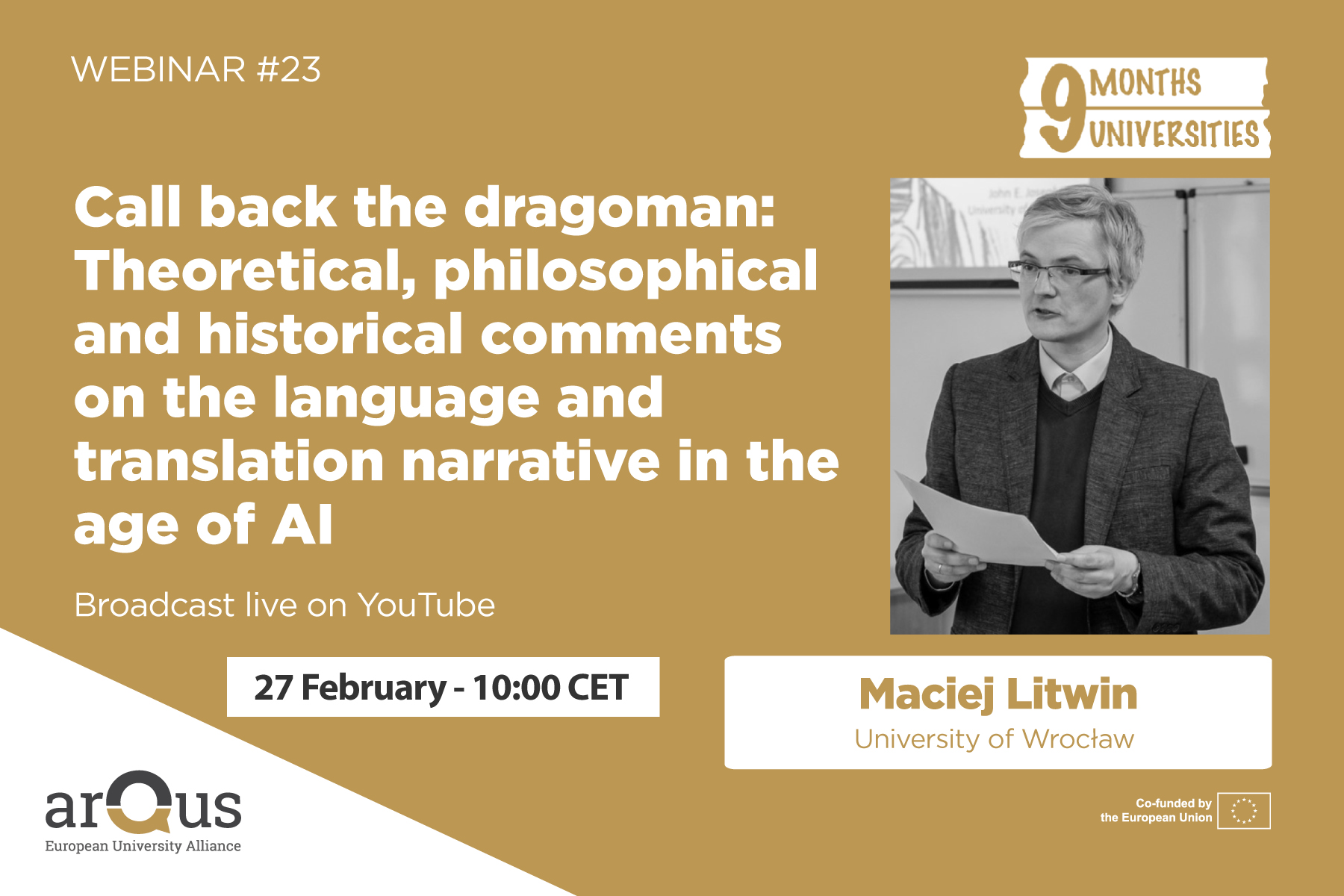
We invite you to join the next session of The 9 Months, 9 Universities series, organised by the University of Wrocław within the framework of the Arqus Plurilingual and Intercultural Hub. The session titled “Call back the dragoman: Theoretical, philosophical and historical comments on the language and translation narrative in the age of AI” will be broadcast live on YouTube on 27 February 10:00 CET.
The Translator’s Charter of 1963 famously articulated the vision for the profession in which an ethical commitment (“faithfulness”, but not “literalness”) was matched with unique multilingual expertise (including superior “exactitude” in “transferring” texts). This professional translator narrative served the emerging twentieth-century technocracy and was soon corroborated by the rapid development of translation studies at European universities.
Today, the reality of digital communication – including Large Language Models (LLM) and AI algorithms – gives access to expert-like outputs outside the translator community. As the technological race continues, there are fewer reasons to assume that human translations as such will continue to be generally better suited for use (cf. Litwin 2025).
Consequently, the sole expertise of the professional group of translators and language experts is being re-defined. Just as fan charts have become an instrument central banks use to communicate uncertainty and ignorance asproper expert knowledge (cf. Kay & King 2020), the language profession is beginning to assert its unique competence in coping with the uncertainty that is at the heart of language model use.
But in addition to stressing the necessity of new skills for the reality of post-editing, one avenue is to decouple the theme of translating from risk-averse, expert-centred and institutionally grounded references and to reclaim the elements of risk, privacy, rupture and even “betrayal” that are inseparable from language communication.
The narrative of the translation profession in the future will be best served by a re-asserted broad notion of translating as well as a renaissance of non-professional translating and literary work, but it may also need to reclaim the legacy of the dragoman, putting the issue of trust rather than merely “quality” at the centre.
Maciej Litwin (cognitive linguistics, PhD 2014) has worked as an assistant professor in the Department of Translation (Institute of English Studies) at the University of Wrocław since 2015. For the first few years, his research focused on the problem of economy in translation theory. His present work has turned to changes to the figure of the translator that have resulted from the technological revolution, as well as to the problem of translator trust. Before joining academia, Maciej Litwin was the Wrocław city hall liaison for university–business–government relations (2008–2015). He was the regional coordinator of the OECD Review of Higher Education in Regional and City Development from 2011 to 2013. In addition, he served on the mayor of Wrocław’s advisory board for education between 2010 and 2018.