
Arqus “AI in teaching & learning: International perspectives and best practices” workshop series – session 1
Type: Arqus, Artificial Intelligence
Format: Online
Open to: Academics & researchers, Teachers
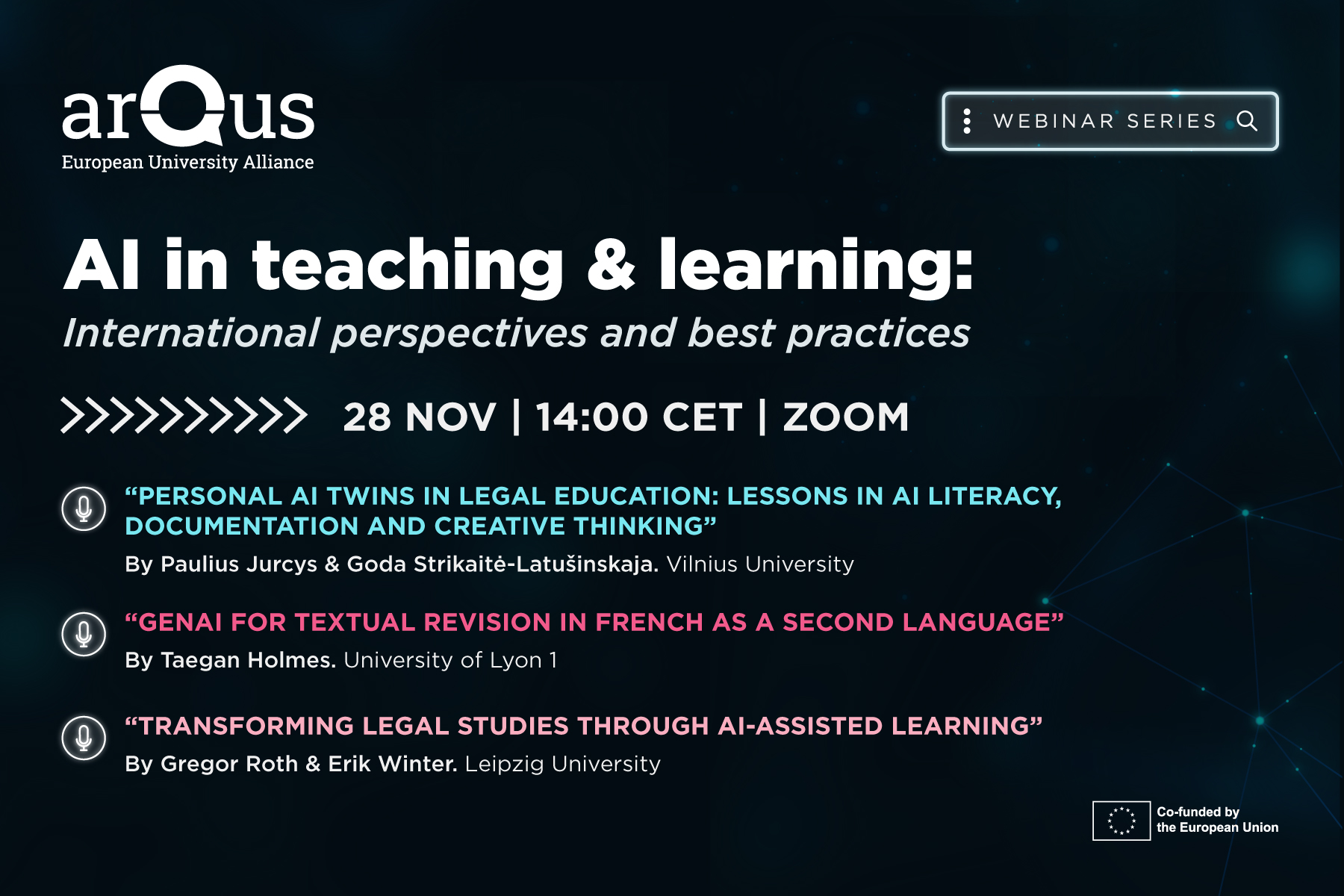
Artificial intelligence is changing university teaching – but how can it be used effectively? In this series of online workshops, experts from Arqus universities share their experiences and challenges in using AI in teaching. The first session of the series will take place on 28 November at 14:00 CET on Zoom.
The “AI in Teaching & Learning: International Perspectives and Best Practices” workshops consist of 90-minute online sessions, in which experts from European universities will share insights into the use of AI-supported applications and present best practices. This workshop series will aim to explore and discuss both the opportunities and challenges that AI brings to the future of teaching.
The first session of the series will feature three talks on three different topics:
- Paulius Jurcys and Goda Strikaitė-Latušinskaja (Vilnius University): “Personal AI Twins in legal education: Lessons in AI literacy, documentation, and creative thinking”.
- Taegan Holmes (University of Lyon 1): “GenAI for textual revision in French as a second language”.
- Gregor Roth and Erik Winter (Leipzig University): “Transforming legal studies through AI-assisted learning”.
All sessions will be held in English and are aimed at teachers, teaching support staff, and didactic experts at Arqus universities. Participation is free of charge, but registration is required.
About the speakers
Paul Jurcys and Goda Strikaitė-Latušinskaja are lecturers at Vilnius University’s Law Faculty, where they teach Data Privacy Law. Their small experiment to integrate gen-AI tools was featured in the OpenAI Global AI Faculty project.
In their presentation, they will report on a pioneering experiment in which two lecturers integrated AI “knowledge twins”—conversational doubles trained on their own materials—into a data protection law course. Rather than replacing instructors, the twins enhanced learning through on-demand expertise, reduced student anxiety, and fostered critical, creative engagement.
The results of this experiment show how thoughtful AI augmentation can advance human-centred, ethically aware education.
Erik Winter is a team member of ChatLEO, an AI project enhancing legal education at the University of Leipzig. He previously worked as a research assistant at the chair of Elisa Hoven, at the Criminological Research Institute of Lower Saxony (KfN), and with Gregor Roth. His work combines law, technology, and education with a focus on innovation in legal learning.
In his talk, Erik Winter will present ChatLEO, exploring how this AI project works by linking questions to precise lecture segments and materials. ChatLEO demonstrates how intelligent systems can make learning more accessible, efficient, and interdisciplinary.
Taegan Holmes is a contractual doctoral student at Université Lumière Lyon 2 in France and a member of the ICAR laboratory. Alongside her studies, she teaches at Lyon 2 and has a Bachelor’s and a Master’s from the University of Ottawa. She has work experience as a teaching assistant, a research assistant, a private tutor, a test item writer and a language professor.
Her presentation focuses specifically on ChatGPT and its application for textual revision in the context of French as a Second Language at the undergraduate level.
She will dive into learning outcomes, uses cases, and explore some critical ethical considerations. The aim of this presentation is to underline the affordances as well as the limitations of using GenAI during the revision process.
Watch the full workshop here: