
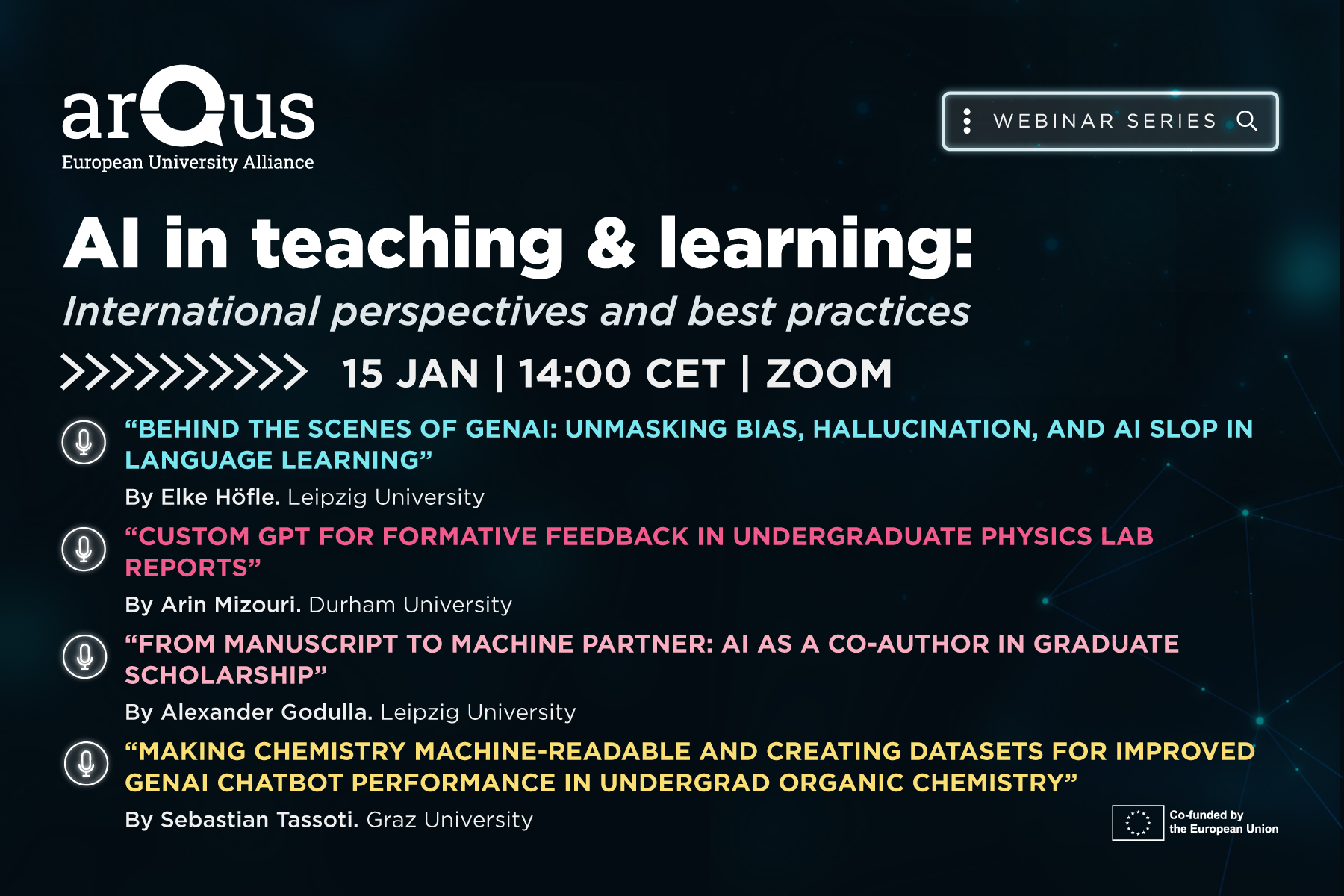
Arqus workshop series: “AI in teaching & learning: International perspectives and best practices” – Session 4
Type: Arqus, Arqus European University Alliance, Artificial Intelligence
Format: Online
Open to: Academics & researchers, Admin. Staff, Early Post-docs, PhD Students, Teachers
Artificial intelligence is changing university teaching – but how can it be used effectively? In this series of online workshops, experts from Arqus universities share their experiences and challenges in using AI in teaching. The second session of the series will take place on 15 January at 14:00 CET on Zoom.
The “AI in Teaching & Learning: International Perspectives and Best Practices” workshops consist of 90-minute online sessions, in which experts from European universities will share insights into the use of AI-supported applications and present best practices. This workshop series will aim to explore and discuss both the opportunities and challenges that AI brings to the future of teaching.
The fourth session will feature three talks on three different topics:
“Behind the scenes of genAI: Unmasking bias, hallucination, and AI slop in language learning” by Elke Höfler (University of Graz)
Artificial intelligence has become a constant companion in language learning – from automated translations to AI-generated feedback. Yet, with this convenience comes new responsibility.
In this talk, the speaker explores how language teacher education can foster critical awareness of AI, presenting three examples from language teacher education that invite future teachers to reflect critically on the promises and pitfalls of AI.
On this examples, students explore how bias shapes output, how hallucinations distort meaning, and how “AI slop” affects linguistic accuracy and authenticity. By analysing their own interactions with AI tools, they learn to move from blind trust to informed awareness.
The aim is to empower pre-service teachers to guide their future learners not only in using AI, but also in understanding it as a cultural, linguistic, and cognitive phenomenon that reshapes what it means to learn and to communicate.
Custom GPT for formative feedback in undergraduate physics lab reports, by Arin Mizouri (Durham University).
This talk will focus on a study at Durham Physics that developed a prompt-engineered, course-aligned GPT to provide formative feedback on first-year lab reports.
The speaker will summarise the initial student survey, highlighting low confidence in writing, show how the model was constrained with rubrics and exemplars, and present evaluation data from 15 students on its usefulness and accuracy.
From manuscript to machine partner: AI as a co-author in graduate scholarship, by Alexander Godulla (Leipzig University)
This talk explores how generative AI reshapes the production of academic books and conferences at the Master’s level.
The speaker will examine AI as a co-author, research assistant, and editorial tool, showing how it can support literature work, argument development, design of scholarly formats, and the creation of high-quality academic outputs.
Making chemistry machine-readable and creating datasets for improved GenAI chatbot performance in undergrad organic chemistry, by Sebastian Tassoti (University of Graz)
For higher chemistry, it is not surprising that GenAI chatbots do not have a lot of training data so it becomes crucial how you prompt the bot.
In this talk, the speaker will present evidence and the design of an intervention done with 45 students in Graz and New York City that focuses on how to make organic chemistry machine-readable and how to write a prompt that trains an LLM to improve performance and use it to predict reactions with higher accuracy.
About the speakers
Elke Höfler is an assistant professor for Educational Technology and Design and language teaching at the University of Graz (Austria).
Her research focuses on artificial intelligence, literature didactics, social media and reading didactics, among other topics. She is an educational blogger and co-founder of an educational network called #EduPnx.
Arin Mizouri is an Assistant Professor of Physics at Durham University, working on practical uses of generative AI in higher education.
She has designed course-aligned custom GPTs to support student learning using evidence from student evaluations, providing formative feedback on lab reports, and creating tutor-style GPTs that guide learners rather than give solutions.
Her teaching foregrounds accessibility, inclusive practice, and active learning.
Alexander Godulla is Professor of Empirical Communication and Media Research at Leipzig University. His work covers AI in media, deepfakes, digital journalism, strategic communication, and international photojournalism. He publishes widely, co-edits a handbook on AI-driven media disruption, and co-leads a research project on the effects of deepfakes.
Sebastian Tassoti is a Senior Lecturer in Chemistry Education at the University of Graz. He is a chemist by training and started working on chemistry education in his post-doc.
Currently, he has several research projects on the use of GenAI in higher chemistry education settings. He does empirical research on students’ use of GenAI chatbots, with a focus on how productive use of such chatbots can be achieved.