
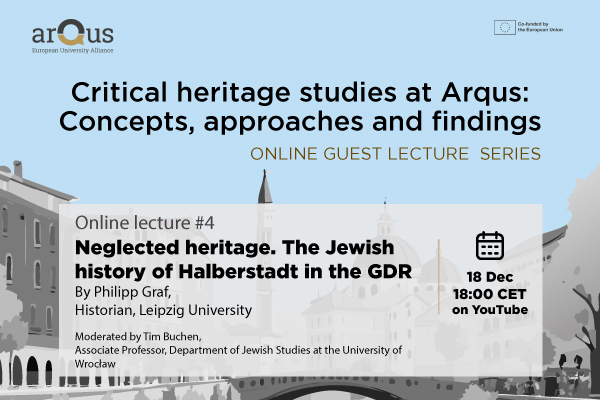
Online lecture – Neglected heritage. The Jewish history of Halberstadt in the GDR
Type: Arqus, Arqus European University Alliance
Format: Online
Open to: Academics & researchers, Admin. Staff, Early Post-docs, General public, HE managers, Master's students, PhD Students, Students, Teachers
Join us on the fourth session of the “Critical heritage studies at Arqus: concepts, approaches and findings” online guest lecture series, titled “Neglected heritage. The Jewish history of Halberstadt in the GDR”, with Philipp Graf (Leipzig University). The online lecture will take place on 18 December at 18:00 CET. Moderated by Tim Buchen, Associate Professor in the Department of Jewish Studies at the University of Wrocław.
Using the example of Halberstadt, the lecture examines the role attributed to Jewish cultural heritage in the GDR. Halberstadt, a picturesque town in the Harz foothills with a history spanning over 1200 years, was home to one of the most important Jewish communities in Central Germany until the Nazi era. Due to its size, this community was closely intertwined with the town’s society and, as a centre of Neo-Orthodoxy since the 19th century, had made a crucial contribution to the religious modernisation of German Jewry. In the workers’ and peasants’ state, this outstanding heritage, eradicated by the Nazis, fell into oblivion and was not commemorated by the socialist public, with tangible consequences for how Judaism and Jewish history are discussed in the former East Germany to this day.
About the speaker
Philipp Graf is a historian and lecturer at the Department of History at Leipzig University. His research interests lie in the fields of Jewish history in the GDR, the history of Holocaust memory, the history of restitution and reparations, and the dissemination of knowledge about Judaism and Jewish history in Germany. His latest publications include: Ausgeschlagenes Erbe. Die jüdische Geschichte Halberstadts in der DDR (Göttingen 2025), Zweierlei Zugehörigkeit. Der jüdische Kommunist Leo Zuckermann und der Holocaust (Göttingen 2024), as well as the three-volume series Themenhefte für den Unterricht (Leipzig 2023–2025) on Jewish everyday culture, for which he was responsible as editor-in-chief.