
4th workshop of the series on AI and language learning and teaching: Rethinking assessment in the GenAI era
Type: Communities of Practice
Format: Online
Open to: Academics & researchers, PhD Students, Students, Teachers
The Community of Practice (CoP) “AI and Languages Learning and Teaching” invites you to its fourth online workshop in a series of meetings and training sessions that will be held on Microsoft Teams.
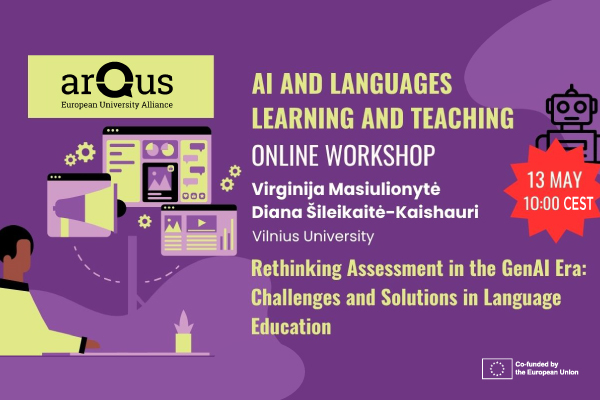
Dr Diana Šileikaitė-Kaishauri and Dr Virginija Masiulionytė (Vilnius University) will deliver a session titled “Rethinking Assessment in the GenAI Era: Challenges and Solutions in Language Education” on 13 May 2026, from 10:00 to 12:00 (CEST).
Workshop description:
This workshop explores how generative AI is reshaping assessment in language education. Given that GenAI can draft, translate, summarise, correct, paraphrase, explain and complete a wide range of tasks, traditional take-home writing assignments and product-based assessments may no longer provide sufficient evidence of students’ independent language abilities.
GenAI poses key challenges for language assessment such as the limitations of GenAI detection tools, the fine line between support and substitution, the risk of over-policing students and the need to assess not only final products but also processes, performance and learner decision-making. Further important questions include authorship, learner autonomy, academic integrity and fairness, as well as the role of GenAI-supported language use in real-world communication.
The workshop will start with a discussion of core principles of language assessment, in particular, validity and authenticity. Particular attention will be paid to the alignment between assessment tasks, learning outcomes, classroom practices and the types of evidence educators need in order to make trustworthy judgments about students’ language development.
The central goal of this workshop is to propose possible solutions, in the process distinguishing between “discursive changes” and “structural changes” (Corbin et al. 2025). The approach of discursive changes highlights the need to establish clear rules for GenAI use in classrooms and courses. The key question in this regard is how to decide when GenAI use should be prohibited, limited, allowed or required and how to communicate these decisions transparently to students.
The second approach encompasses practical assessment redesign ideas such as in-class “snapshot” tasks, oral follow-ups, process portfolios, GenAI-supported revision tasks, reflective journals, prompt logs and critical evaluation of AI-generated output. Modifying the assessment task itself enables the shift from product-based to process-based assessment, which captures the student’s development over time and ensures assessment validity in the GenAI era.
References: Corbin, T., Dawson, P., & Liu, D. (2025). Talk is cheap: why structural assessment changes are needed for a time of GenAI. Assessment & Evaluation in Higher Education, 50(7), 1087–1097. https://doi.org/10.1080/02602938.2025.2503964.