
Type: Arqus Talent and Innovation Fund
Format: In-person
Open to: General public
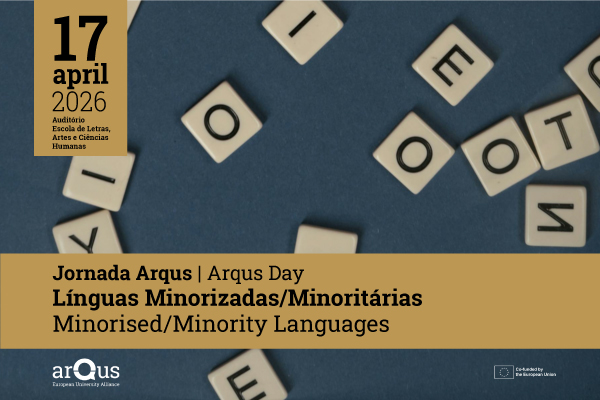
The School of Arts and Humanities at the University of Minho (Portugal) will host the Arqus Day on Minorised/Minority Languages on 17 April, an event dedicated to the promotion and dissemination of linguistic diversity across Europe. It will take place in Auditório Escola de Letras, Artes e Ciências Humanas at University of Minho.
The initiative, organised by the bottom-up project “Beyond majority languages: research dissemination and teaching promotion of minority and minoritised languages in Europe”, was funded by the Arqus Innovation Fund 2024. The event aims to foster reflection on the status, teaching and revitalisation of minority languages, bringing together researchers and educators working in different linguistic contexts.
The event programme includes the following lectures:
- “Is Galician a minoritised form of Portuguese?” by Fernando Groba Bouzaanother
- “A brief introduction to Guinea-Bissau Creole” by Alfredo da Silva and Domingos da Silva
- “Mirandese: the current state of affairs and pathways to linguistic vitality” by Cláudia Martins and Joana Aguiar
Fernando Groba Bouza | “Is Galician a minoritised form of Portuguese?”
Based on the common origin and history of Galician and Portuguese, this paper will analyse their process of separation and, by way of comparison, examine the current situation of each of these languages.
About the speaker
Fernando Groba Bouza holds a degree in Galician Philology from the University of Santiago de Compostela and a doctorate in Linguistic Studies from the Universities of Vigo and A Coruña. He has been a Galician language lecturer at the University of Minho, a language standardisation officer for the councils of Porto do Son and Tomiño, and a collaborating professor for the General Secretariat for Language Policy of the Xunta de Galicia. Currently, he is a secondary school professor at the IES do Barral de Ponteareas (Pontevedra, Galicia). His studies to date cover topics in Sociolinguistics, Phraseology, Terminology, Lexicography, Linguistic Geography and the History of Galician Literature.
Alfredo da Silva and Domingos da Silva | “A brief introduction to Guinea-Bissau Creole: some of its structures (gender and number inflection) and lexical similarities”
This work presents a brief analysis of the structures of Guinea-Bissau Creole (Kriol), a language with a Portuguese lexical base and a syntax influenced by the Niger-Congo language group. The Creole (Kriol) acts as a factor of ethnic cohesion and national identity, although it retains a position of “political minority” vis-à-vis Portuguese, the official language.
The theoretical framework is based on the autonomy of the Kriol system, which, according to Scantamburlo (2002), possesses a rigorous internal logic independent of the Romance languages. The aim is to describe this autonomy along two axes: nominal morphology and the lexicon. It will be demonstrated that gender and number formation is analytical and contextual, dispensing with systematic agreement (e.g. tris omi), and, at the lexical level, semantic extensions and ‘false friends’ (e.g. pekadur) will be examined.
The authors aim to demonstrate the grammatical robustness of the language, advocating for its full formalisation within the education system, arguing that Kriol is a tool for national unity and advancement, and should transition from being a socially dominant but politically marginalised language to a status of full legal and scientific recognition.
About the speakers
Alfredo José Marques da Silva graduated with a degree in Portuguese Language from the “Tchico Té” Higher Teacher Training College in the 2009/2010 academic year. He was a professor and coordinator at the “José Marty” Regional Secondary School in Bolama (1993–2028), a professor at the Samora Moisés Machel Secondary School in Bissau (2017–2028), and a professor and evening coordinator at the Rui Barcelos da Cunha Secondary School in Bissau (2019–2023). He is currently a master’s student in Portuguese as a Non-Native Language (MPLNM) at the University of Minho, with an interest in analysing the role of students’ native languages in the process of learning Portuguese in secondary education, within the Guinean context.
Domingos Joaquim da Silva is a second-year master’s student in Portuguese as a Non-Native Language (PLNM) at the University of Minho, Portugal. He holds a bachelor’s degree in Portuguese Language from the Tchico Té Higher School of Education (in cooperation with the Camões Institute in Bissau). With four years’ experience as a Portuguese language teacher in Guinean primary education, his professional work is characterised by a dedication to teaching Portuguese in multicultural contexts. He is currently conducting dissertation research focused on “Lexical Interference from Creole (L1) in the acquisition of Portuguese (L2) in primary education (Years 7 and 9) in Guinea-Bissau”, a project aimed at directly contributing to the improvement of PLNM teaching methodologies in Guinea-Bissau.
Cláudia Martins and Joana Aguiar | “Mirandese: the current state of affairs and pathways to linguistic vitality”
Language policy has a significant impact on education, in that it has the power to shape the linguistic awareness and proficiency of future generations, thereby influencing national, regional or group identity in the long term. In the case of minority languages, education and translation take on crucial importance. The teaching of these languages is linked to a range of factors, including their official recognition within the country, their presence in higher education institutions and the creation of teaching resources. Translation is often regarded as an additional revitalisation strategy, aimed at preventing linguistic decline and laying the foundations for building the ‘future of the past’—an expression used by Romaine (2008, p. 8) to refer to the sustainability of minority languages in the face of politically and socially dominant languages.
On the other hand, language preservation is closely linked to the media. This relationship is particularly relevant in the case of regional or minority languages, where the media perform various functions, ranging from informing the public to reinforcing community identity, and can also serve as a tool for linguistic activism.
This workshop focuses on Mirandese, a language with just 1,500 regular speakers (compared to 3,500 people who know it, according to Costas, 2022) and whose presence can be considered marginal. Our aim is twofold: 1) to describe the ‘history’ of Mirandese language teaching, presenting data on where the language is taught, how many people are learning it and what resources are available or have been created, in order to provide an overview of the current state of Mirandese; 2) to map the media practices that have emerged over the last decade across various platforms, from the print media to social media, as well as the roles they play within the Mirandese community.
About the speakers
Cláudia Martins holds a PhD in Translation from the University of Aveiro, with a thesis on museum accessibility for people with visual impairments. She obtained a Diploma in Advanced Studies in Translation and Intercultural Studies in Spain and holds a master’s degree in Terminology and Translation and a bachelor’s degree in Modern Languages and Literatures from the Faculty of Arts at the University of Porto. Since 2001, she has been teaching English as a Foreign Language, English Linguistics, Terminology and Audiovisual Translation at the School of Education of the Polytechnic Institute of Bragança. Her research interests include English language teaching, Linguistics, Minority Languages (with a particular focus on Mirandese), Phraseology and Paremiology, Terminology, Audiovisual Translation and Media Accessibility. She is part of the COST Action PLURILINGMEDIA (CA23105), where she serves as a member of the Management Committee representing Portugal, a member of the core group, and science communication coordinator.
Joana Aguiar is a researcher at the Centre for Transdisciplinary Research in Education and Development (CITeD) and a Visiting Lecturer at the School of Education of the Polytechnic Institute of Bragança. She holds a PhD in Language Sciences – specialising in Sociolinguistics – from the University of Minho (2017) and has participated in research projects funded by the Foundation for Science and Technology in the areas of phonological frequency patterns, sociolinguistic variation and online hate speech. She is a member of the COST Action PLURILINGMEDIA (CA23105). Her main areas of research are linguistic variation and forensic linguistics. She is currently conducting research on the sociolinguistic profile of Portuguese speakers residing in Andorra (Camões Chair / University of Andorra).