
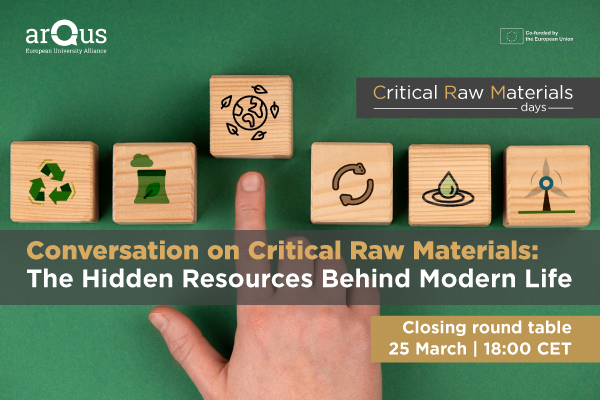
Closing session of the Critical Raw Materials days: The hidden resources behind modern life
Format: Online
Open to: General public
The Critical Raw Materials days is an initiative organised by the Universities of Granada, Minho, Padua, Vilnius and Wroclaw. It comprises a series of activities designed to explore the significance of Critical Raw Materials, understand the challenges they bring, and promote more responsible and efficient management of these essential resources.
Critical Raw Materials (CRM) have become a strategic cornerstone for industrial and technological development. Their availability shapes competitiveness, drives innovation, and underpins the transition toward more sustainable energy systems.
The CRM Days, to be held from 9 to 25 March, comprise a set of CRM‑related activities, including online talks in English open to participants from any country, as well as local events held in the languages of the organising universities. All activities are outreach‑oriented and aimed at non-specialised audiences of different ages.
Closing session (online)
Wednesday, 25 March | 18:00 CET
Language: English
Conversations on Critical Raw Materials: The hidden resources behind modern life
Moderator:
- Teresa Maria Fernandes Valente (Portugal): mineralogist specialising in the environmental impacts of mining. Her expertise provides essential insights into the environmental challenges associated with the extraction of Critical Raw Materials.
Roundtable panellists:
Anna Potysz (Wrocław, Poland): environmental scientist specializing in the recovery of mineral resources from secondary sources, with a focus on biometallurgy.
Rafael Navarro Domínguez (Granada, Spain): geologist at the Geological and Mining Institute of Spain, and an expert in industrial minerals and rocks with extensive experience in the fluorite sector.
Luis Albardeiro (Aljustrel, Portugal): geologist specializing in mineral resources and critical raw materials, with a focus on resource assessment, sustainable extraction strategies, and the geological factors that influence CRM availability.
Paolo Nimis (Padua, Italy): geologist specialising in mineralogy, geochemistry, and ore deposits, with extensive research experience on the metallogeny of strategic metals.
Vaida Kirkliauskaitė (Vilnius, Lithuania): petrologist with broad experience in the CRM potential of the Baltic countries and in the exploration challenges of Phanerozoic‑covered regions.
The session will be held online and conducted in English. The activity is open to the general public, non-specialised audiences and participants of all ages.