8 March. Women, academia and freedom: a conversation with an Iranian student
Arqus
|
08 Mar 2026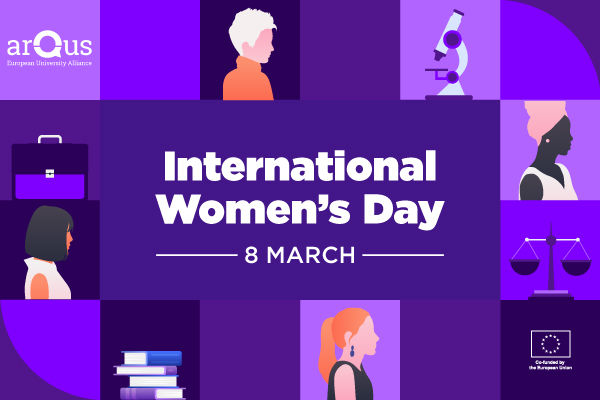
|
08 Mar 20268 March is neither a symbolic date nor a reassuring celebration. It is a moment that challenges the present, especially when we speak about rights, access to knowledge and freedom of thought. In many parts of the world, being a woman and wanting to study is not a neutral choice: it is a deeply human struggle for dignity, autonomy and safety.
On the occasion of International Women’s Day, I spoke with Aida, an Iranian PhD candidate enrolled at an Arqus university. Aida, like so many other young Iranians, had to leave her family and home behind and move abroad to pursue her dreams. She defines her beloved homeland as “a country of four seasons, rich in history, art, and literature, the oldest civilisation on earth, famous for its Persian carpets and saffron”. She notes that, unlike many other languages, Persian is a language without gender distinction, which reflects its culture of equity. Iran has a long history of valuing human rights: the Cyrus Cylinder, recognised as the world’s first charter of human rights, was written in ancient Persia.
Aida had to leave Iran to continue her studies and live without being worried about basic human rights. She felt that, despite all its beauty, current Iran would not allow her to fully realise her potential or receive the recognition she deserved. For her, women’s rights are not an ideological or political concept, but something profoundly human. They concern the freedom to choose, to speak, to study, to move freely, and to live with dignity. They mean being able to walk in the street without fear, to dress as one wishes, to laugh, to sing, and to pursue one’s dreams freely: something that, she stresses, should be possible for every woman.
Aida situates Iranian women’s struggles within a much longer historical trajectory. She points out that many people are unaware that strong, educated women have always been part of Persian history. As early as ancient Persia, during the Achaemenid Empire and the era of Cyrus the Great (around 550 BC), women could own property, manage estates, and receive wages for their work, rights that were not recognised in many other societies at the time.
She recalls figures such as Atossa, the daughter of Cyrus the Great and wife of Darius I, who played an important political and social role, as well as Queen Boran in the Sasanian Empire, who ruled with wisdom and sought to promote education and social stability. Persian women, she notes, have also been prominent as poets, writers and thinkers, such as Rabia Balkhi, the tenth-century poet.
This legacy did not disappear with modernity. Before the 1979 Islamic Revolution, Iranian women had broad access to education and professional opportunities. Many became doctors, lawyers, judges, professors, and active participants in cultural life. They contributed to art, theatre, literature, and helped shape modern Iranian society. History clearly shows that women’s education, talent and leadership are deeply rooted in Persian culture.
Against this historical background, the current situation appears deeply ironic. Today, Iranian women continue to face severe restrictions in their most basic freedoms: choices about what to wear, how to express themselves in public, and how to live their daily lives. Aida highlights concrete legal inequalities: a married woman cannot travel abroad without her husband’s permission; she cannot initiate divorce; and under Islamic law, if a woman is killed, the compensation for her death is legally valued at half that of a man.
Despite these constraints, Iranian women have continued to find ways to express themselves through education, art, culture, and solidarity. She mentions figures such as Anousheh Ansari, the first Iranian person to travel into space, and Maryam Mirzakhani, the first woman in history to win the Fields Medal in mathematics. Yet she also underlines a painful reality: these women, like many others, were able to thrive only outside Iran. Emigration often becomes the only viable path for women who wish to realise their potential.
Iran, Aida explains, has very good universities, and women make up around 60% of the student population. Persian women have a strong desire for education, and they invest enormous effort in their studies. However, the effort is rarely matched by opportunities or rewards. Many professional and artistic paths are effectively closed to women. Fields such as singing, dancing, music, cinema, acting, gymnastics, ballet, and even professional swimming are heavily restricted or impossible to pursue due to moral and religious regulations, including strict dress codes. As a result, education often does not translate into professional freedom or self-realisation.
For Aida, International Women’s Day is not about victimhood, but about connection and solidarity. Persian women, she insists, do not want to be seen as passive victims. They want to be recognised as strong, capable individuals who deserve the same basic freedoms as women anywhere else.
At this point, I feel the need to add a personal reflection: when Aida says that Iranian women do not want to be seen as victims, I do not think of them simply as resilient. I think of them as fighters. What they are doing is not symbolic resistance; it is real, embodied struggle.
Protesting, speaking out, studying, or even living freely as a woman in Iran involves risks that are almost impossible to imagine from a European perspective. In Iran, women are killed for resisting. Their families are threatened, imprisoned, or destroyed.
This makes the label of “victim” not only insufficient but misleading. Iranian women act with a level of courage that implies full awareness of the dangers they face. They know the risks, and yet they continue. That is the opposite of victimhood: it is conscious, courageous resistance.
Despite everything, for Aida, hope persists. Iranian women are paying a very high price, but their strength has not been erased. That strength lives on in mothers, sisters, friends, and the next generation, and hopefully could be taken as an example in other countries. And when women support each other across borders, when stories are shared, listened to, and taken seriously, real change becomes possible, and progress can continue.
So let’s keep talking about women at risk, their courage, and their fights – today, 8 March, and every day.
An article by Elisa Gamba, University of Padua, PhD candidate in Human rights, society and multi-level governance.
The author wishes to clarify that this article was written on 12 February 2026. It does not in any way endorse or justify the recent bombings and acts of violence carried out unlawfully on Iranian territory. The use of force cannot serve as a legitimate pathway to peace or stability.