Arqus staff strenghten collaboration at a training event in Wroclaw
Arqus
|
10 Apr 2026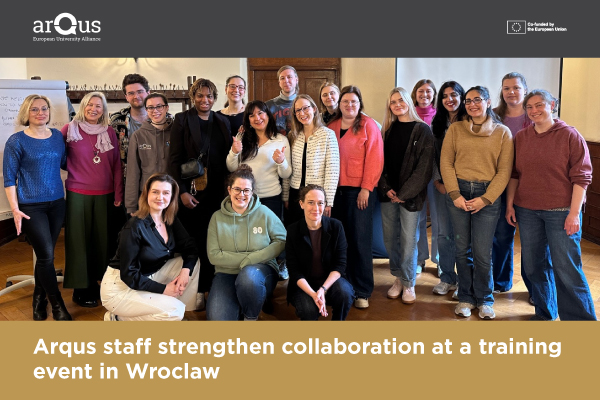
|
10 Apr 2026Staff members from across Arqus universities gathered in Wroclaw, Poland, from 24 to 26 March 2026 for a three-day training funded by the Polish National Agency for Academic Exchange (NAWA).
The workshop brought together international relations and communications staff from Arqus universities in Vilnius, Leipzig, Wroclaw, Padua, Granada and Maynooth. The training was led by an external lecturer and trainer, who guided participants through a series of sessions focused on communication, intercultural understanding and collaboration within international academic networks.
The three-day programme combined practical workshops, reflection sessions and networking opportunities. Participants began by exploring cultural differences and communication styles, including high-context and low-context communication models, before moving on to frameworks such as the SBI (Situation-Behaviour-Impact) model for constructive feedback and Nonviolent Communication (NVC).
The programme also addressed the realities of digital and hybrid work environments. Sessions on media richness, active listening in virtual meetings and strategies to reduce “camera fatigue” encouraged participants to reflect on how to communicate more effectively and sustainably across online platforms.
In addition, staff discussed global perspectives through Erin Meyer’s Culture Map and took part in a workshop designed to move from theory to practice. Alongside the formal sessions, participants had the opportunity to strengthen personal connections during a welcome dinner and a guided city tour around Wroclaw.
Throughout the workshops, participants explored how cultural differences shape everyday interactions and decision-making within cross-border teams. By engaging with established communication models and practical frameworks, they examined how misunderstandings emerge, how feedback can be delivered constructively, and how to navigate the nuances of global academic environments.
These shared reflections helped participants recognise not only the richness of perspectives within the Alliance, but also the common obstacles they face when working across languages, disciplines and institutional cultures.
Hands-on activities encouraged staff to translate theory into practice, experimenting with new approaches to communication, active listening and virtual collaboration. Discussions often returned to the realities of hybrid work: how to stay present in online meetings, how to maintain clarity across digital channels, and how to manage the fatigue that can come with constant connectivity.
These conversations highlighted a collective desire to build healthier, more sustainable working habits across the Alliance. Participants left with a stronger sense of community, a clearer understanding of the challenges they face together, and a renewed commitment to fostering open, empathetic communication across Arqus.