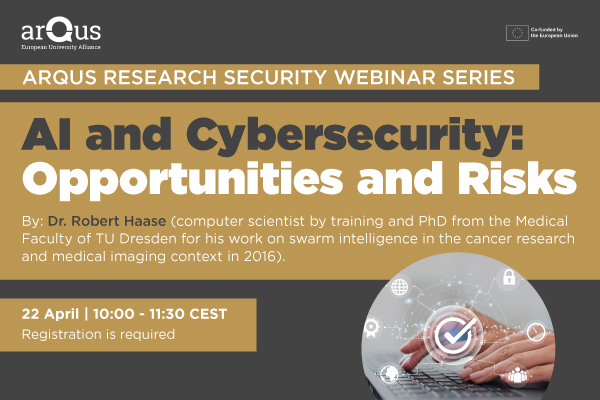
Join the second Research Security webinar: AI and cybersecutity: Opportunities and risks

Arqus

|

17 Feb 2026
Generative Artificial Intelligence (GenAI) systems are revolutionizing the way humans interact with computers. Cumbersome tasks such as finding relevant documents for answering specific questions can suddenly be supported by computers to a degree that full automation appear within reach. Systems which achieve this level of autonomy are referred to as AI-agents.

AI-agents can answer emails, make appointments, browse all documents an institution ever created, and all that within seconds or minutes. However, when we enable GenAI systems to answer questions on our behalf, this also opens doors for new kinds of cybersecurity attacks.

In this webinar, organized by the Leipzig University and funded by the Arqus Innovation Fund (2025 call), we will see AI-agents in action helping with administrative tasks and for scientific question answering. We will also learn what attack-angles these systems potentially open to raise awareness. Finally, we will learn about measures that can be taken to keep AI-agents under control with state-of-the-art technology.

The webinar is open for the general public. If you want to participate, you need to fill this registration form to join the session that will take place on 22 April from 10 to 11.30h CET.

About the speakers

Dr. Robert Haase is computer scientist by training and received a PhD from the Medical Faculty of TU Dresden for his work on swarm intelligence in the cancer research and medical imaging context in 2016. Since 2023 he has been working at the National AI Competence Center ScaDS.AI at Leipzig University as Lecturer and Training Coordinator. His research focus are autonomous AI-systems for scientific data analysis and he regularly trains students, scientists and non-scientists in how to use Artificial Intelligence for a wide variety of tasks, including data analysis, responsible use, data protection, legal aspects and cybersecurity.

If you have any questions please get in contact with harald.kleinberger-pierer@uni-graz.at.

Newsletter

Don’t miss any news, calls or opportunities from Arqus.
Subscribe now! The future begins today.

    Subscribe


    You can change your mind at any time by clicking the unsubscribe link in the footer of any email you receive from us.

    We use Mailchimp as our marketing platform. By clicking below to subscribe, you acknowledge that your information will be transferred to Mailchimp for processing. Learn more about Mailchimp's privacy practices here.

    Controller: University of Granada (as Coordinator of the Arqus European University Alliance). Legal basis: Arqus is entitled to process your data under the provisions of Article 6.1. (a) of the GDPR: “the data subject has given consent to the processing of his or her personal data for one or more specific purposes”. Purpose: to manage your subscription to mailing lists and to periodically send you the requested information by electronic means. Recipients: Mailchimp. Rights: access, object, rectification, erasure, restriction of processing, data portability. Additional information here.

    Select our profile:

    Apart from the general information, what specific news would you like to receive from Arqus?

    Controller: University of Granada (as Coordinator of the Arqus European University Alliance). Legal basis: Arqus is entitled to process your data under the provisions of Article 6.1. (a) of the GDPR: “the data subject has given consent to the processing of his or her personal data for one or more specific purposes”. Purpose: to manage your subscription to mailing lists and to periodically send you the requested information by electronic means. Recipients: Mailchimp. Rights: access, object, rectification, erasure, restriction of processing, data portability. Additional information here.

    Arqus
    Privacy Overview

    This website uses cookies so that we can provide you with the best user experience possible. Cookie information is stored in your browser and performs functions such as recognising you when you return to our website and helping our team to understand which sections of the website you find most interesting and useful.