Join the new webinar in the “9 Months, 9 Universities” series on how family, school and society shape bilingual development
Arqus
|
13 Mar 2026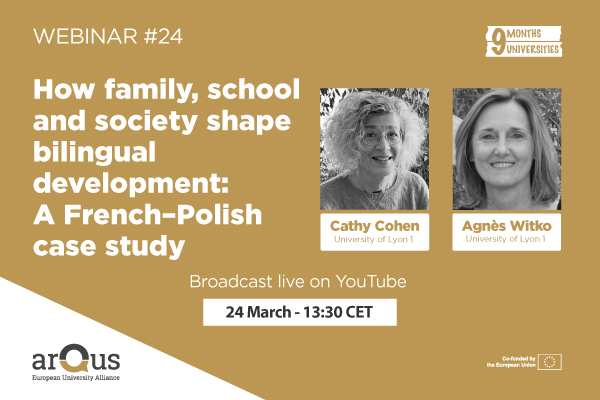
|
13 Mar 2026We invite you to join the next session of The 9 Months, 9 Universities series, organised within the framework of the Arqus Plurilingual and Intercultural Hub. The session titled “How family, school and society shape bilingual development: A French–Polish case study” will be broadcast live on YouTube on 24 March at 13:30 CET.
This time, experts will explore how bilingualism develops in children growing up in multilingual environments and how family practices, educational settings and broader social contexts interact in shaping language development.
The presentation will focus on the bilingual experience of three French–Polish siblings raised in a mid-to-high socioeconomic family using a one-parent-one-language strategy and enrolled in a state bilingual programme in France. Through a detailed family language biography, the study investigates how children experience and actively shape bilingualism, highlighting the richness of their linguistic environment.
Parental data were collected through semi-structured interviews based on a standardised questionnaire. At the same time, the children completed several tasks designed to capture their linguistic perceptions and abilities. These included an experimental questionnaire, a drawing activity in which they coloured a representation of the languages in their brain at home and at school, a description of a family interaction at the dinner table and a Rapid Automatised Naming test conducted in both languages.
Despite differences in their early language experiences, the siblings show balanced bilingual profiles. Their development reflects dominant exposure to French alongside sustained use of Polish, with equivalent performance in the naming test in both languages. The findings highlight the role of both maternal and children’s agency in maintaining Polish within the family environment. More broadly, the study suggests that bilingual experience can be understood as a multi-level habitus – temporal, familial and institutional – that supports harmonious bilingual development.
Dr Agnès Witko is an Associate Professor in Language Sciences and a speech and language therapist at the University of Lyon 1 Claude Bernard, within the Institute of Rehabilitation Sciences and Techniques (ISTR). She is also a member of the Dynamique du Langage research laboratory (DDL). Her research focuses primarily on dyslexia, bilingualism and language disorders. In addition to her academic work, she contributes as an expert to public policy guidelines on neurodevelopmental disorders. Dr Witko is a member of the Scientific Committee of SimuLyon, Vice-President of the Ethics Committee of COMUE Lyon Saint-Étienne (CER-UdL) and Editor-in-Chief of Glossa, a scientific journal dedicated to speech and language therapy.
Dr Cathy Cohen is an Associate Professor in English and Language Sciences in the Faculty of Education (INSPÉ) at the University of Lyon 1 Claude Bernard. She is a member of the ICAR research laboratory (Interactions, Corpus, Learning, Representations) and of the Labex ASLAN. Her research examines bilingual language acquisition in children, with a particular focus on how language exposure and use shape bilingual development, the growth of narrative abilities, family language practices and the construction of cultural identity. She also serves as the International Relations Officer for INSPÉ at the University of Lyon 1 Claude Bernard.