New workshop series: Weekly language workshops for teaching in English
Arqus
|
16 Dec 2025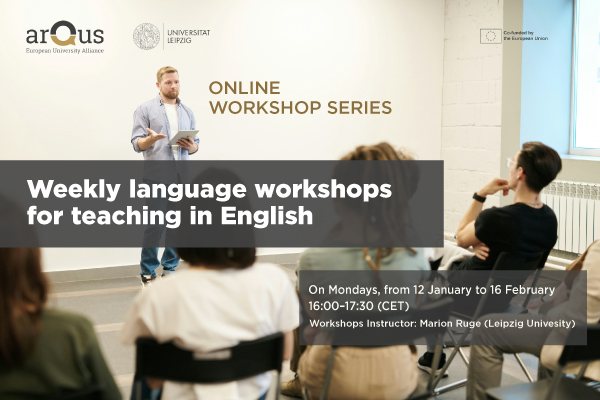
|
16 Dec 2025The workshop series Weekly language workshops for teaching in English, is designed to support instructors who teach their subjects through English by addressing both practical skills and common challenges. The sessions will take place on Mondays from 12 January to 16 February from 16:00 to 17.30 CET.
Throughout the series, participants will exchange ideas, experiment with useful language and techniques, and reflect on how to enhance clarity and confidence in their classrooms.
The first session of the series will give participants a forum to exchange experiences, and challenges of teaching through English. Then the next sessions will focus on essential issues such as improving fluency, giving effective feedback in English, assessing students’ academic writing and helping students to develop strong presentation skills.
The workshop series will conclude with an open session to address remaining questions or concerns. Participants can share insights, discuss specific challenges, and plan how to apply what they’ve learnt in their own teaching.
In this opening workshop, participants will exchange experiences and challenges of teaching through English. We’ll identify common themes and practical approaches for building confidence and effectiveness in EMI contexts.
Explore practical strategies to speak more confidently and naturally in the classroom. This session will help you build fluency, reduce hesitation, and communicate clearly with your students in English.
Learn how to give clear, supportive, and constructive feedback in English. This workshop will focus on useful language, tone and techniques to encourage student improvement and motivation.
Gain insight into what constitutes effective academic writing in English and how to recognise it in your students’ work. This session will focus on key criteria such as clarity, structure and appropriate academic style.
Discover effective ways to help students plan, structure and deliver presentations in English. This workshop will offer language support for guiding students toward academic public speaking.
This concluding session will provide an opportunity to revisit key themes from the series and address remaining questions or concerns. Participants can share insights, discuss specific challenges and plan how to apply what they have learnt in their own teaching.
Dr Ruge has been teaching English for Specific Purposes (ESP) at institutions of higher education for almost 40 years. In this role, her responsibilities have included designing courses in a wide variety of subjects, selecting appropriate teaching materials and creating activities that facilitate a student-centered approach to foreign language acquisition. She currently works at the Language Center at Leipzig University.
Course materials co-developed by Dr Ruge and Dr Caroline Allen.
Dr Allen studied secondary education in England and moved to Germany in 2013. After several years of teaching business English, she shifted her focus to English for Specific Purposes (ESP). Her PhD examined how English courses can be designed to meet the specific needs of learners in medical contexts.
She now teaches at Leipzig University, where she develops and delivers ESP courses for students in the natural sciences, and her work centres on helping learners build confidence and become the English speakers they aspire to be.
Contact: wp11arqus@uni-leipzig.de
No more registrations are accepted. The course is fully booked. Information updated on 23 January 2026.