The University of Lyon 1 joins the Arqus “Libraries of the Future” Community of Practice in Durham
Arqus
|
08 Apr 2026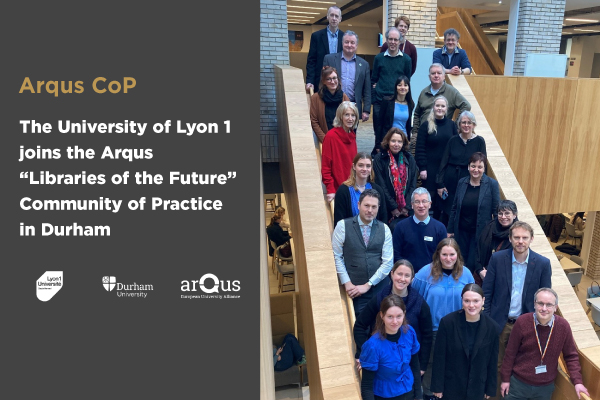
|
08 Apr 2026On 14–15 January 2026, The University of Lyon 1 Claude Bernard took part in a seminar organized at Durham University as part of the “Libraries of the Future” Community of Practice, focusing on heritage collections and archives.
Two members of the Lyon 1 Library, Livia Rapatel, Curator and Head of Cultural Programming and Heritage Collections, and Karine Delvert, Research Data and Documentation Assistant at the Research Services Department, attended the seminar held at Durham University, within the framework of the “Libraries of the Future” Community of Practice.
This marked the first time the University of Lyon 1 was represented and actively participated in this series of events, an involvement warmly welcomed by both community members and coordinators.
The Arqus “Libraries of the Future” Community of Practice was established in 2024 on the initiative of Cathal McCauley from Maynooth University. It brings together Maynooth, Minho, Granada, Graz and Lyon 1. One of its goals is to identify the skills necessary for libraries to effectively support their institutions, both now and in the future. This highly active community works on various themes -artificial intelligence, heritage, open science, internationalization, and user training- explored through seminars where each university presents its flagship projects.
Below, you can read the insights of Livia Rapatel and Karine Delvert:
Our presentation aimed to showcase the richness and diversity of the University of Lyon 1 heritage collections, with a focus on the Library’s treasures.
We presented our conservation efforts, our partnership with the National Library of France for digitization, and initiatives to promote our collections. Examples included blog posts on Interfaces/Ancient Books highlighting rare or historically significant scientific works, videos on our remarkable collections, the “Heritage Corner” designed to introduce students to old books in an interactive way, and public exhibitions in collaboration with researchers.
We also outlined the University’s strategy for enhancing its scientific heritage, including the development of a Collections Master Plan and a communication plan centered on exceptional items.
Within our professional community, we share many concerns regarding conservation, digitization, collection promotion and heritage preservation. Exchanging practices is enriching and motivating, fostering collaborations and the sharing of experiences.
The seminar offered many particularly inspiring initiatives, including innovative ways to involve audiences (especially young ones) in collection promotion, and engaging researchers in heritage conservation projects. For instance, Andy Beedy, a Chemistry Professor at Durham University, presented portable instruments and non-invasive analysis methods for rare books and manuscripts, developed in collaboration with library services using multispectral analysis techniques.
Several presentations also illustrated how research projects can be built around collections, how collections can be integrated into teaching, and how archivists and librarians can act as partners in research projects rather than merely facilitators of access.
We also observed differing approaches, such as the frequent use of patronage and private funding to support document restoration (at University of Durham or University of Graz).
Finally, initiatives for lifelong learning (e.g., “Show and Tell” at Maynooth) or professional training for young staff through apprenticeships and internships were also discussed.
We have similar projects with some CoP members, such as digitizing heritage collections, creating digital libraries, enhancing specific collections, and addressing conservation challenges.
The seminar helped us identify contacts at partner universities and, more broadly, connect with English- and German-speaking professional networks through Arqus. Concretely, we are developing a digital library project to enable online access to our digitized collections. Durham University uses the same technical solution as our Documentation Service, and meeting their Digital Strategy Officer allowed us to exchange technical choices. We shared this contact with our project lead.
A colleague we met at the seminar visited us in early February, providing an opportunity to showcase the Science Library and our heritage collections, including Alexandre Lacassagne’s tattoo notebooks, previously presented at the seminar.
These events foster privileged contacts and professional networks across the Alliance, based on shared professional practices and tools (library management systems, digital libraries, etc.).
Participation in the CoP activities enhances our understanding of partner universities’ operations (training, academic calendars, research areas, administrative management) and internationalizes our activities.
Our involvement undoubtedly strengthens our sense of belonging to the Arqus Alliance and to a professional community facing common challenges (e.g., open science, AI).
For the University of Lyon 1 Claude Bernard, this event was an opportunity to highlight its expertise, identify new collaborations, and consolidate its commitment within the Arqus Alliance.
Useful links: