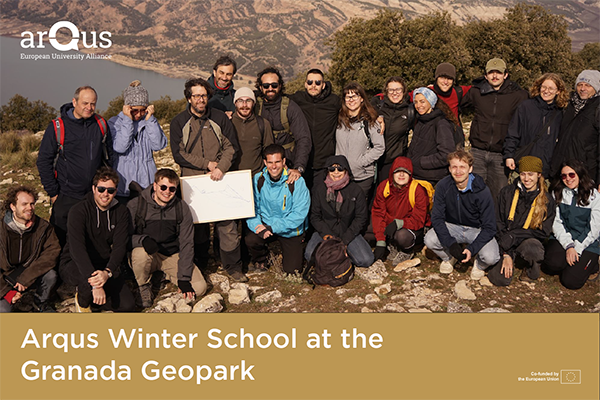
The Arqus Winter School at Granada Geopark (17–22 February 2025) was a comprehensive, week-long programme that combined theoretical lectures, practical sessions, and field excursions.
Nineteen students from Italy, Germany, and Spain were guided by an international team from Leipzig University, the University of Padua, and the University of Granada.
The programme featured in-depth lectures on erosion, geophysics, archaeology and modern surveying techniques, alongside hands-on fieldwork at key sites such as the Desierto de Gorafe, the travertine formations of Alicún de las Torres, and the Baza Fault.
Feedback by students
“The Granada Winter School was a great opportunity to explore the geological, geomorphological, and archaeological features of the Guadix Basin in a hands-on and engaging way. Over the course of the week, we worked through a well-structured program that combined lectures, guided site visits, and practical geophysical fieldwork. This allowed us to cover a broad range of topics, including the tectonic development of the region, sedimentary layering, changes in paleoenvironments during the Quaternary, and traces of early human presence. The structure of the course made it easy to build up knowledge gradually, from understanding the background theory, to seeing real-world examples at key locations, and finally applying geophysical methods ourselves in the field.
Our fieldwork encompassed a diverse set of methods, including Electrical Resistivity Tomography (ERT), Ground Penetrating Radar (GPR), geomagnetic surveying and drone-based orthophotography. Each technique not only offered a practical introduction to environmental and archaeological geophysics but also revealed meaningful insights into the subsurface structures and geomorphological processes at our study sites. We got to learn valuable skills tailored for a future in environmental data sciences.
Beyond the technical aspects, the field trip fostered valuable interdisciplinary collaboration between students and instructors from Leipzig, Granada and Padova. Working in international teams encouraged the exchange of perspectives and promoted an integrated understanding of Earth system science. We can also say with confidence that this excursion brought us valuable connections and new friendships to the universities and people from Spain and Italy.
In sum, this excursion not only deepened our academic and methodological knowledge but also highlighted the importance of field-based research in addressing present and future challenges in sustainable land management, heritage preservation, and environmental change. The experience also underscored the core values of the UNESCO Global Geopark initiative: conservation, education, and sustainable development.
We want to thank Prof. Dr. Djamil Al-Halbouni for organizing and initiating this project and all contributors from the 3 collaborating Universities as well as Arqus Alliance for making this excursion possible. Although not everything went according to plan it was an amazing experience and we hope that this project can get continued in upcoming years.”