Interview with researcher Mario Nicolás López Martínez to mark Europe Day
Arqus
|
09 May 2026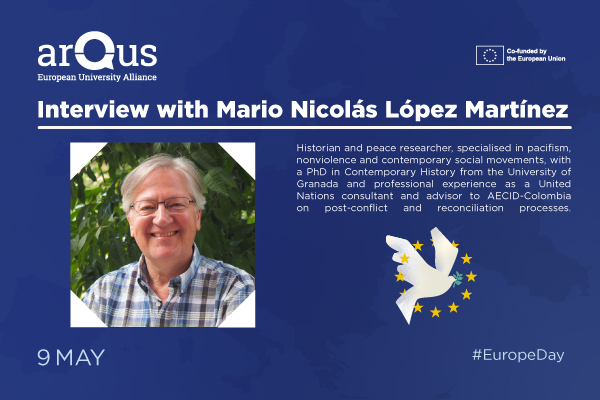
|
09 May 2026To mark Europe Day on 9 May, we have launched a series of interviews with leading researchers and experts on European affairs, inviting them to reflect on the current situation facing our continent. At a time shaped by geopolitical tensions, social uncertainty and major global challenges, these conversations aim to provide insight and critical perspectives on Europe’s present and future.
In this first interview, we speak with Mario Nicolás López Martínez, who holds a PhD in Contemporary History from the University of Granada and teaches Contemporary Social Movements at the Faculty of Political Science and Sociology. He is also a researcher at the Institute of Peace and Conflict in the same city.
With a background in history, his work focuses on the theory, thought and practice of pacifism and nonviolence. He has worked as an international consultant for the United Nations on post-conflict and reconciliation issues, and has also served as an advisor to the Spanish Agency for International Development Cooperation (AECID) in Colombia.
Defending peace and Human Rights makes profound sense because contemporary history shows that the aftermath of war is marked by broken generations, deep trauma, wounded memories, and fractured societies. There are always victors and defeated peoples, but the consequences endure far beyond the battlefield. Every real and significant advance of humanity has emerged from struggles for peace and justice: the abolition of slavery, universal suffrage, social rights, decolonization, and feminist achievements. All of these were struggles for human dignity in which peace proved more revolutionary than war.
Moreover, Human Rights represent one of humanity’s greatest achievements because they embody an attempt to reach a common understanding of what it means to be human, condemning racism, xenophobia, exclusion, marginalization, and discrimination. Human Rights are revolutionary because, from an ethical and political standpoint, no power or interest should stand above human dignity. And that will remain a permanent struggle.
In my case, research has played a decisive role because it has allowed me to demonstrate that violence and wars are not an inevitable accident of history, but rather a human construction and, therefore, something that can be transformed. In fact, I have devoted myself to researching the History of Peace, including struggles for Human Rights, movements for the recovery of historical memory, processes of recognition of victims, the search for truth, and the contributions of social movements for peace, among many other issues.
Moreover, this work has enabled me to travel to other societies, participate in mediation and negotiation processes, and advise governments on the promotion and dissemination of a culture of peace. Thanks to my commitment to Human Rights and peacebuilding, I have been able to give my historical knowledge a useful, practical, and deeply rewarding dimension.
When I think of Europe, I think of a profound historical paradox: a continent that unleashed and fostered some of the most devastating wars in history and that nevertheless managed to build one of the most ambitious peace projects in the contemporary world. The paradox becomes even greater when one studies the immense work carried out by bourgeois-liberal, labour, feminist, internationalist, and humanist pacifism to abolish war, create systems of arbitration, promote cooperation among peoples, dismantle nationalism, and defend Human Rights.
It is a largely unknown history, yet a fascinating one. Many of the strongest arguments used today against wars were already being articulated in the first half of the nineteenth century. Even the idea behind today’s Erasmus university exchange programme was discussed at some of the universal peace congresses held in the final third of the nineteenth century. Yet Europe also reminds us that peace is never definitive: it requires memory, democratic vigilance, and a constant defence of Human Rights.
Europe still holds immense potential as a geopolitical actor because it possesses diplomatic capacity, historical experience, multilateral institutions, and a normative culture grounded in Human Rights, cooperation, and dialogue. Europe is an economic giant, endowed with a remarkably high standard of material well-being and sophisticated systems of social protection, yet it remains a fragmented and hesitant political actor. For decades, Europe has continued to debate what its role in foreign affairs should be and how it ought to respond to the world’s most painful and destabilizing conflicts.
What Europe lacks is a truly unified voice and the ability to project a firm and coherent political will. The resources undoubtedly exist, but Europe must overcome a certain political infantilism and its longstanding external dependencies, transforming itself into a genuine common home rather than a territory still haunted by the embers of the Cold War. If Europe aspires to become an authentic political power, it must lead a renewed diplomatic offensive in defence of an international order grounded in international law, while forging new alliances and overcoming old conflicts, suspicions, and inherited stereotypes.
Naturally, many things concern me: the normalization of war, the denial of genocides, rampant neoliberalism, discourses of hatred, and the dehumanization of the “other.” All of this seemed to belong to the twentieth century, not the twenty-first. Human suffering must never be trivialized, nor should we look away in the face of such lacerating injustices. I am equally troubled by politics driven by fear, the arms race, and the hegemonic rivalries fuelled by capitalism and new technologies. And yet, despite all this, I remain hopeful. Studying the past in depth has given me a certain intellectual immunity.
Rights and freedoms can indeed be lost, but it will not be an easy task for the prophets of doom. Human freedom and dignity are part of our innate spirit of rebellion. Hope is neither naïveté nor certainty about the future; it is a form of intellectual and moral resistance. As long as there are people capable of defending human dignity against barbarism, history has not yet spoken its final word.
You can read the other interviews of this Europe Day series here.