
9 Months, 9 Universities webinar: Constructional patterns in child-bilingual code-mixing
Type: Arqus Plurilingual and Intercultural Hub
Open to: Academics & researchers, Students
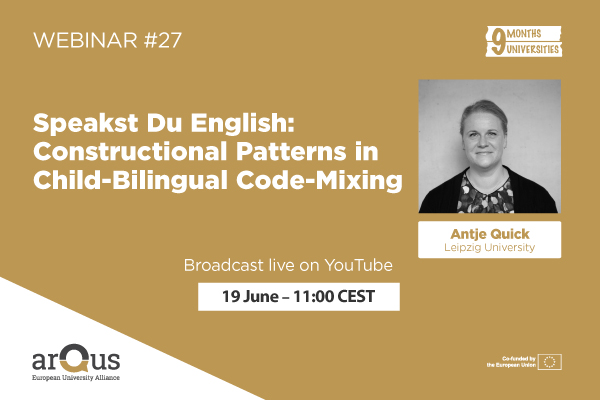
We invite you to join the next webinar in the 9 Months, 9 Universities series, organised within the framework of the Arqus Plurilingual and Intercultural Hub. The session titled “Constructional Patterns in Child-Bilingual Code-Mixing” will take place online on 19 June 2026 at 11:00 CEST.
Code-mixing, broadly defined as the use of more than one language within a single utterance, is a common feature of bilingual communication. Although children’s code-mixing is sometimes viewed negatively in public discourse, research in bilingualism has shown that multilingual language use can have important communicative and cognitive advantages. From a usage-based perspective, code mixing offers valuable insights into how children acquire languages. Usage-based approaches assume that children learn language through repeated exposure to meaningful input and gradually identify recurring patterns and constructions.
Within this framework, code-mixed utterances can help reveal the “building blocks” children rely on during early language development. These include chunks such as What’s this? and more flexible frame-and-slot patterns such as What’s X?, where elements from different languages may fill particular slots, for example, What’s das da (what’s this there). Such patterns illustrate how children build increasingly productive linguistic knowledge from recurrent usage events.
This webinar explores how code-mixing data can deepen our understanding of bilingual child language acquisition and challenge deficit-oriented views of multilingualism. By combining insights from bilingualism research and usage-based linguistics, the session highlights code-mixing as a systematic and meaningful aspect of bilingual language development rather than a sign of confusion or linguistic limitation.
About the speaker
Antje Quick is a senior research associate in the Department of English Studies at Leipzig University. She received her PhD (Dr phil) in English Linguistics from Leipzig University after completing her doctoral studies at the Max Planck Institute for Evolutionary Anthropology in Leipzig, Germany (2008–2012). In 2023, she also completed her habilitation at FAU Erlangen-Nürnberg. Her research focuses on multilingual first language acquisition and language contact phenomena from a usage-based perspective. It pays particular attention to lexically specific patterns and their role in the development of syntactic productivity.