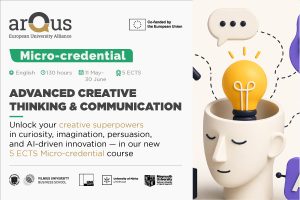
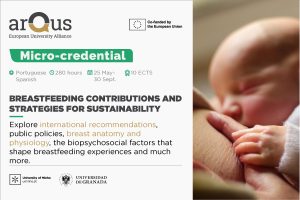
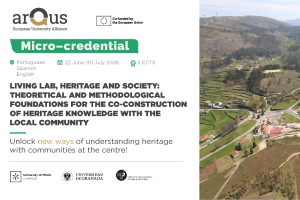
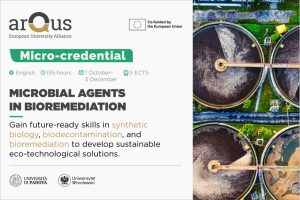
Micro-credentials are the record of the learning outcomes that a learner has acquired following a small volume of learning. They certify the learning outcomes of short-term learning experiences, for example, a short course or training. They offer a flexible, targeted way to help people develop the knowledge, skills and competences they need for their personal and professional development.
Micro-credentials are designed to enable learners to acquire specific knowledge, skills and competences that meet social, personal, cultural or labour market needs.
They are considered a shorter form of learning opportunities than traditional qualifications. They also have the potential to offer education and training opportunities to a wider range of learners, including disadvantaged and vulnerable groups.
Arqus micro-credentials are distinctive and present added value, first and foremost in their collaborative nature. All Arqus micro-credentials must be jointly prepared and implemented by at least two universities of the Alliance, making them all collaborative, international experiences for the learner. External partners (e.g. industry, labour market, NGOs) and non-Arqus universities can participate as well. Because of the joint nature of Arqus micro-credentials, they provide a multi-cultural learning environment. Arqus micro-credentials have also been developed to help promote the Arqus priority areas of Equality, Inclusion and Sustainability, Climate Change and Environmental Sustainability, Digital Transformation and Artificial Intelligence, and European Identity and Heritage.
The participating universities and organisations develop and sign a mutual agreement document.
The cost for each micro-credential varies depending on the universities involved. For more information, please consult the information page dedicated to each micro-credential.
All registration information can be found on the information page dedicated to each micro-credential.
All successfully completed Arqus micro-credentials are awarded ECTS. The number of ECTS depends on the length and difficulty of the learning experiences. The ECTS are recognised by the partner universities as part of an existing course pathway or as an elective, according to the modalities decided by the partner universities.
Arqus micro-credentials vary in length from one another. Courses can be offered in-person, online or in blended and hybrid modes. The most adapted course format is decided on by the partner universities to provide the optimal experience to learners.