Arqus researchers explore science through theatre in an international seminar at the University of Padua
Arqus
|
06 Feb 2026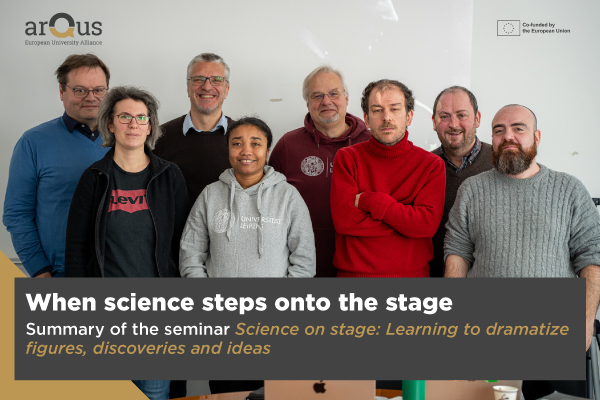
|
06 Feb 2026From Monday 19 January to Thursday 22 January, the School of Psychology at the University of Padua hosted an unusual and inspiring seminar that invited researchers to look at science from a completely different angle — the stage.
As part of the funded bottom-up initiatives within the Arqus Alliance, the seminar Science on stage: learning to dramatize figures, discoveries, and ideas was led by Prof. Filippo Bruschi from Université Paris Nanterre. It brought together researchers from the Universities of Padua, University of Graz, and Leipzig University, creating a truly international and interdisciplinary learning environment.
The goal of the initiative was both ambitious and creative: to guide participants in developing a theatrical text capable of bringing scientific figures and ideas to life. With a particular focus on pioneers of psychology, the seminar explored how complex research, discoveries, and intellectual debates can be transformed into compelling narratives for a wider audience.
Over the course of four days, participants worked with a mix of theoretical insights and hands-on exercises, learning how to build a structured project dossier for a potential performance. This included defining the scientific figure to be portrayed, identifying target audiences, mapping possible production partners, and situating the story within its historical, social, and political context. A central theme throughout was the importance of showing scientists not only as thinkers and innovators, but also as human beings shaped by their time, choices, and contradictions.
A special focus was devoted to Vittorio Benussi, the first professor of psychology at the University of Padua. A brilliant researcher and an early pioneer in what would later become known as the “lie detector”, Benussi’s life unfolded between Italy and Austria during the turbulent years of the First World War. His scientific work, personal trajectory, and historical context proved particularly powerful material for theatrical dramatization.
Beyond individual figures, the seminar encouraged participants to reflect more broadly on how scientific ideas themselves can be staged — how abstract concepts can become accessible, emotionally engaging, and narratively compelling without losing their rigor. Overall, the seminar was a highly rewarding experience that demonstrated how science communication can benefit from creative and alternative approaches, opening new possibilities for dialogue between research, art, and society — and reminding us that science, too, can tell unforgettable stories.
Article by Prof. Grassi