Human Rights Café in Granada: Reflecting on democracy, migration and environmental justice
Arqus
|
14 Apr 2026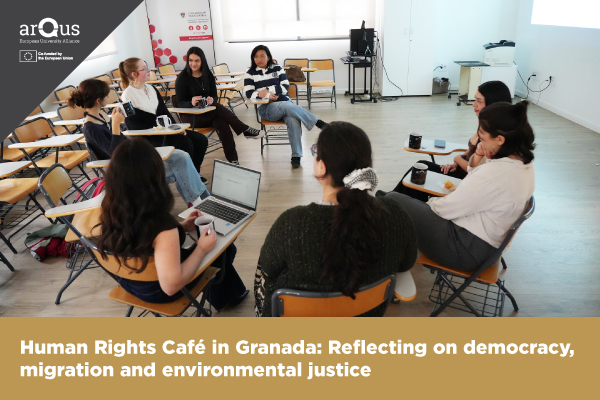
|
14 Apr 2026The latest edition of the Human Rights Café in Granada brought together students and participants from different backgrounds in a discussion that moved across three closely connected themes: populism and far-right ideology, migration, and environmental justice. At a time when democratic societies are facing increasingly complex challenges, having spaces where people can talk openly and exchange ideas feels more important than ever.
While each of these topics opened a different line of reflection, they all pointed back to a broader question: how democratic societies respond to uncertainty, inequality, and political change.
The conversation began with an attempt to clarify what is meant by populism and far-right ideology. Participants described populism as a way of framing politics around a divide between “ordinary people” and political elites, often appealing to those who feel excluded or unrepresented. Far-right ideology, on the other hand, was associated with positions that move further away from core democratic principles, such as human rights and the rule of law. Rather than simply reflecting conservative views, it was linked to authoritarian tendencies, strong nationalism, and exclusionary ideas about belonging.
A recurring point in the discussion was that these movements tend to gain support during periods of dissatisfaction and polarization. When political debates become more divided, simplified explanations can become more persuasive.
In this context, populist actors often present themselves as the voice of “the people”, while attributing complex social or economic problems to specific groups, including migrants or minorities.
Participants also reflected on the role of nostalgia within these narratives. References to an idealized past can make exclusionary politics appear more attractive, especially when present conditions feel unstable or difficult to navigate. This was seen not only as a rhetorical strategy, but as something that can shape how people interpret current political challenges.
What emerged clearly from the discussion is that the impact of these movements is not limited to their ideas, but extends to how democratic systems function. Participants noted that far-right politics often operate within democratic frameworks rather than outside them.
This can make their effects less immediately visible, as changes may take place gradually, through legal reforms, institutional shifts, or changes in public discourse, rather than through abrupt breaks with democratic structures.
Migration formed the second major part of the conversation and was approached from a human rights perspective. Participants pushed back against the idea that migration should be understood primarily as a problem, noting instead that it is a long-standing and complex social phenomenon. At the same time, they observed that migration is frequently framed in negative terms within political and media debates.
A central point was the unequal way in which different groups of migrants are perceived.
In the Spanish context, participants noted that migrants from Latin America or Africa often face greater barriers and experiences of discrimination, while migrants from other European countries may be received more positively. This contrast highlights how perceptions of migration are shaped not only by legal categories, but also by cultural, racial, and economic factors.
The discussion also touched on bureaucratic challenges. Lengthy and complex administrative procedures can create frustration both for migrants and for the wider public, while leaving individuals in prolonged situations of uncertainty. Questions of belonging also emerged, particularly in relation to people born in Spain to migrant parents who may still be perceived as outsiders despite their social and cultural ties to the country.
The final part of the discussion focused on environmental justice. Although this topic received less time, it added an important dimension to the conversation. Participants reflected on the imbalance between those who contribute most to climate change and those who are most affected by its consequences.
This led to broader considerations about responsibility, particularly at the level of governments and corporations, as well as the need for stronger international cooperation.
Overall, the Human Rights Café highlighted how issues such as populism, migration, and environmental justice are closely interconnected. While they are often discussed separately, they influence one another in ways that shape both political debates and lived experiences.
For many participants, the discussion reinforced the importance of approaching these topics through a focus on rights, responsibility, and inclusion. At the same time, it showed the value of creating spaces where students can engage critically with complex issues, exchange perspectives, and reflect beyond simplified narratives.
The event also pointed to a broader need for continued engagement. Rather than remaining confined to a single discussion, these conversations can develop into further initiatives, ideas, and projects.
In this sense, the Human Rights Café does not only create a moment of reflection, but can also act as a starting point for more sustained student-led involvement in promoting and protecting human rights.
Written by Shahnawaz Bhutto – MA in Human Rights and Multilevel Governance
Edited by Sofia Tamagni – MA in Human Rights and Multilevel Governance