
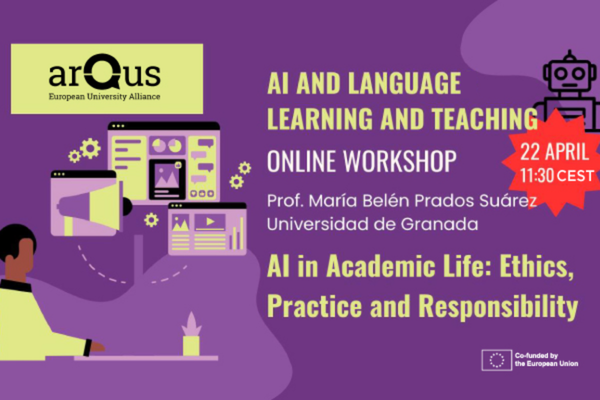
First workshop of the series on AI and language learning and teaching: AI in academic life – Ethics, practice and responsibility

22 APRIL2026

Type: Communities of Practice

Format: Online

Open to: Academics & researchers, PhD Students, Students, Teachers

The Community of Practice “AI and languages learning and teaching” invites you to its first online workshop in a new series of meetings and training sessions that will be held on Microsoft Teams.

Prof. María Belén Prados Suárez (University of Granada) will deliver a session titled “AI in academic life: Ethics, practice and responsibility” on 22 April 2026, from 11:30 to 13:30 (CEST).

Workshop description:


Artificial intelligence is profoundly transforming the way we teach, conduct research and generate knowledge. Tools that automate routine tasks allow us to devote more time to high‑value academic activities whereas new possibilities – once distant or even unimaginable – are opening up in fields such as academic production and the design of learning experiences.

However, these opportunities also bring up a number of ethical questions. What happens to data privacy? Can AI use generate or amplify inequalities? To what extent is it legitimate to delegate pedagogical decisions to algorithms? Does it impact students’ autonomy, creativity or skill development? And what about its effects on the environment?

This workshop offers a critical, practical and accessible overview of the ethical challenges AI presents in our daily academic life and examines how it affects everyday tasks. In addition, it will focus on the responsible use of generative tools and the integrity of our university work. The workshop is an invitation to adopt an active and reflective role and to integrate these technologies responsibly, inclusively and in line with the values of the ARQUS community.

During the session, we will move from technological fascination to informed judgement. In the process, we will explore ethical frameworks, the real risks involved and strategies for using AI. These include having sound criteria, using critical thinking, and establishing a firm commitment to equity and academic quality.

Newsletter

Don’t miss any news, calls or opportunities from Arqus.
Subscribe now! The future begins today.

    Subscribe


    You can change your mind at any time by clicking the unsubscribe link in the footer of any email you receive from us.

    We use Mailchimp as our marketing platform. By clicking below to subscribe, you acknowledge that your information will be transferred to Mailchimp for processing. Learn more about Mailchimp's privacy practices here.

    Controller: University of Granada (as Coordinator of the Arqus European University Alliance). Legal basis: Arqus is entitled to process your data under the provisions of Article 6.1. (a) of the GDPR: “the data subject has given consent to the processing of his or her personal data for one or more specific purposes”. Purpose: to manage your subscription to mailing lists and to periodically send you the requested information by electronic means. Recipients: Mailchimp. Rights: access, object, rectification, erasure, restriction of processing, data portability. Additional information here.

    Select our profile:

    Apart from the general information, what specific news would you like to receive from Arqus?

    Controller: University of Granada (as Coordinator of the Arqus European University Alliance). Legal basis: Arqus is entitled to process your data under the provisions of Article 6.1. (a) of the GDPR: “the data subject has given consent to the processing of his or her personal data for one or more specific purposes”. Purpose: to manage your subscription to mailing lists and to periodically send you the requested information by electronic means. Recipients: Mailchimp. Rights: access, object, rectification, erasure, restriction of processing, data portability. Additional information here.

    Arqus
    Privacy Overview

    This website uses cookies so that we can provide you with the best user experience possible. Cookie information is stored in your browser and performs functions such as recognising you when you return to our website and helping our team to understand which sections of the website you find most interesting and useful.