
Application dates
This micro-credential will open its application process on 1 November 2026 and it will close on 1 February 2027.
Apply by 1 February
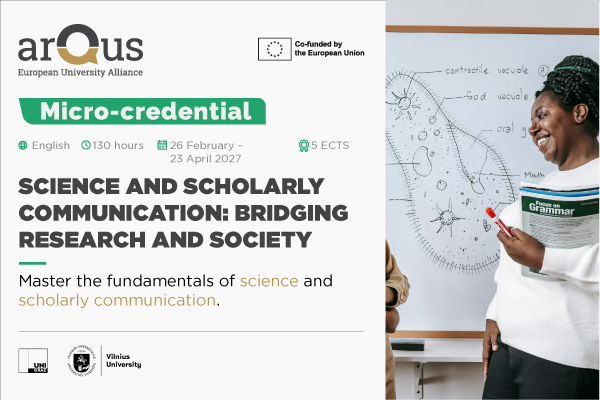
This micro-credential introduces students to the ecosystems of scholarly and science communication, exploring their purposes, audiences, and infrastructures, developing an understanding of the academic publishing lifecycle, open science practices, and strategies for communicating research to the public.
During the programme students will learn to apply this knowledge in academic, professional, and societal contexts through ethical, multimodal, and audience-tailored communication.; developing communication strategies and put them into practice by writing lay summaries, press releases, crafting posts for social media, and learning the basics of visual and multimedia storytelling.
Throughout the course, learners will develop skills in science communication for public and policy audiences to work on a capstone project that integrates theory and practice by developing a communication strategy and producing two deliverables: one scholarly and one tailored for a broader audience.
Find out more about this micro-credential here:
This micro-credential will open its application process on 1 November 2026 and it will close on 1 February 2027.
Arqus bachelor and master’s students, as well as lifelong learners who have an interest in research or academic work
500 € for lifelong learners; free of charge for Arqus degree students.
From 26 February 2027 to 23 April 2027.
Online
University of Graz and Vilnius University.
Vincas Grigas, is an associate professor at Vilnius university Communication Faculty and works at the intersection of scholarly communication, open science and digital publishing, with an interest in how academic knowledge is created, shared and discovered online. As Head of Scholarly Journals at Vilnius University Press, he oversees more than 45 open-access journals and brings extensive international experience from initiatives such as Crossref and the Arqus Open Science Ambassador Network. In his teaching, he connects academic expertise with practical insights into how scholarly communication is evolving in the digital age.
Hildrun Walter is a research associate for science communication at the University of Graz. Since 2018, she has been working at the Center for Society, Science and Communication. Her main research interest lies in the evaluation of strategies and formats of science communication. In her lectures, training and workshops, she explores the role of science communication in society and aims to help participants refine their own communication strategies. With the focus on bridging research and society, she further engages as an Open Science Ambassador in the European University Alliance Arqus.
Vilnius university:
University of Graz
This area is only available with your @arqus-alliance.eu account. On the next Google screen, choose that account (or “Use another account” if it is not listed).
If you see a 404 error, you are signed in with a different Google account (for example, a personal Gmail).