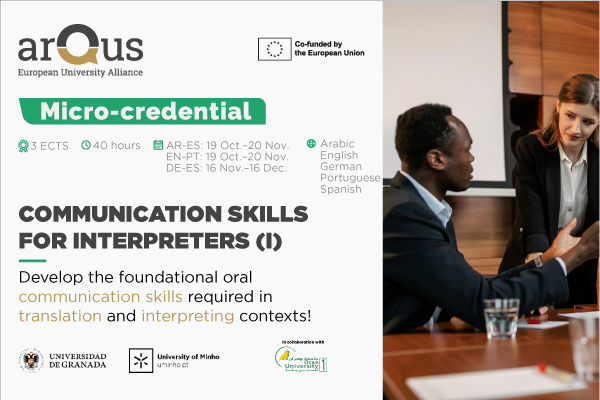
Communication skills for interpreters (I) micro-credential
Train your ear. Sharpen your message. Find your voice. A practical micro-credential designed to strengthen the core communication skills every future interpreter needs.
This microcredential develops the foundational oral communication skills required in translation and interpreting contexts. It strengthens active listening, discourse analysis, reformulation, paraphrasing, verbal and non-verbal communication strategies, and the ability to process and reproduce spoken discourse clearly and accurately.
It is conceived as the first stage of a stackable learning pathway leading to Communication Skills for Interpreters (II).
The microcredential covers foundational oral communication skills for translation and interpreting. The first 2 ECTS focus on core skills in the A language, including analysis and synthesis, reformulation and paraphrasing, non-verbal communication, active listening, and interpersonal and intercultural communication. The final 1 ECTS is devoted to the practical application of these skills in realistic communicative scenarios involving the A language and a selected B language.
Training activities simulate interpreting and oral translation contexts through interactive approaches such as project- and problem-based learning, role-playing and simulation, rotating task modules, and learning portfolios. Assessment is based on performance tasks, PBL assignments, a reflective portfolio, video recording and playback analysis, and peer/collaborative feedback.
If the number of applications exceeds the number of places available, admission will be granted on a first-come, first-served basis. If the minimum number of students required to run the course is not reached, the registration fee will be fully refunded.
Develop foundational oral communication competencies for translation and interpreting students
Strengthen active listening, discourse analysis, reformulation, paraphrasing, and verbal/non-verbal communication strategies
Enable learners to process and reproduce spoken discourse with clarity and accuracy through guided practice and simulated communicative scenarios.
Prepare learners for more specialised training in interpreting
Learning outcomes
Critically analyse and synthesise oral discourse
Reformulate and paraphrase spoken content
Interpret and apply non-verbal communication strategies
Demonstrate advanced active listening skills
Employ problem-solving and improvisation techniques
Engage in collaborative, student-centred learning activities
Target audience profile
Applicants enrolled in a Bachelor’s or Master’s programme with a specialisation in Translation and/or Interpreting, or in a related field. Arqus students and Oran 1 students are given priority, and applicants from Translation and Interpreting Studies are prioritised over those from other disciplines.
Admission requirements
Applicants must be enrolled in a Bachelor’s or Master’s programme with a specialisation in Translation and/or Interpreting, or a related field. They must also demonstrate proficiency in their B language, with a minimum level of B2 or an equivalent certification.
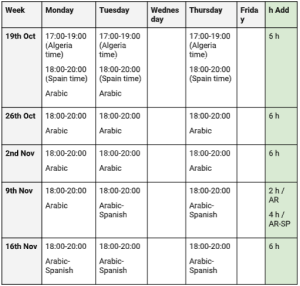
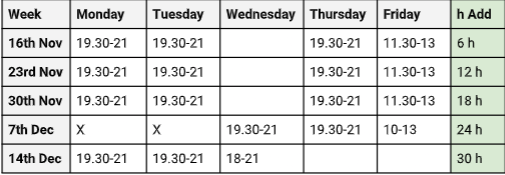
Teaching dates and timetable
DATES:
Arabic – Spanish: 19 October – 20 November 2026
German – Spanish: 16 November – 16 December 2026
English – Portuguese: 19 October – 20 November 2026
TIMETABLE:
Arabic – Spanish
(Spanish time)
German – Spanish
(Spanish time)
English – Portuguese
(Portuguese time)
Tuesdays from 11.00 to 13.00h
Thursdays from 16.00 to 18.00h
Fridays from 14.00 to 16.00h
Mode of delivery
Blended format (in person for those students based locally; fully online for those based elsewhere)
Number of ECTS
3 ECTS. Total student workload: 40 hours, including 30 contact hours and 10 independent work hours.
Language(s) of instruction
Arabic, English, German, Portuguese and Spanish.
Participating institutions
Coordinating institution: University of Granada
Other participating institutions: University of Minho and University of Oran 1 (Algeria)
Teaching staff involved
Bachir Mahyub Rayaa (University of Granada)
Abel Felipe (University of Granada)
Mercedes García (University of Granada, coordinator)
Ana Teresa Correia (University of Minho)
Isabel Pinto (University of Minho, pending approval)
Salah Eddine Salhi (University of Oran 1 – Ahmed Ben Bella)
Meriem Hamdouche (University of Oran 1 – Ahmed Ben Bella, pending approval)
Contact person
Do you have any questions? Please email:
Prof. Mercedes García de Quesada. Associate Professor and Head of the
Department of Translation and Interpreting at the University of Granada
(UGR): gquesada@ugr.es