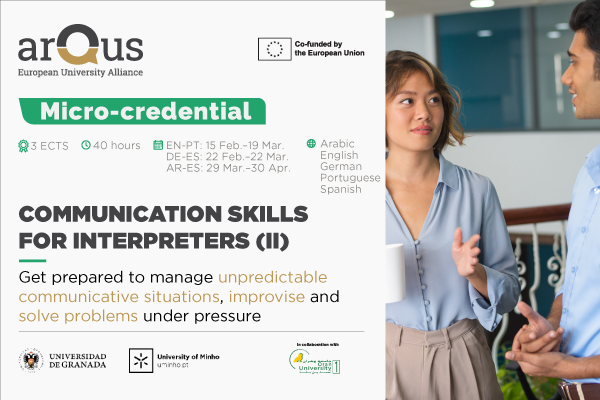
15 February - 30 April 2027

Communication skills for interpreters (II) micro-credential

From communication skills to interpreting agility. Develop the strategic, cognitive and intercultural skills needed to perform confidently in demanding multilingual settings.

This microcredential consolidates and expands the oral communication skills developed in MC1 by introducing more complex communicative tasks and cognitively demanding interpreting-related challenges. It prepares learners to manage unpredictable communicative situations, improvise and solve problems under pressure, handle specialised terminology in real time, and navigate complex interpersonal and intercultural dynamics.

The microcredential builds on Communication Skills for Interpreters (I) and covers advanced oral communication and interpreting-related skills.

Core content areas include improvisation and problem-solving; interpersonal and intercultural negotiation in interpreting; terminological agility and cognitive flexibility; and memory and attention enhancement techniques. The final 1 ECTS focuses on the practical application of these skills in realistic communicative scenarios involving the A language and a selected B language.

Activities simulate interpreting and oral translation contexts through project- and problem-based learning, role-playing and simulation, rotating task modules and learning portfolios. Assessment includes advanced performance-based simulations, PBL assignments, a reflective learning portfolio, video recording and playback analysis, and peer/collaborative feedback.

Objectives

  • Consolidate and expand students’ oral communication skills through more complex communicative tasks and interpreting-related challenges
  • Enhance learners’ ability to manage unpredictable communicative situations, develop improvisation and problem-solving strategies, handle specialised terminology in real time, and navigate complex interpersonal and intercultural dynamics
  • Refine communicative agility, cognitive flexibility and strategic decision-making in multilingual contexts


Learning outcomes

  • Integrate previously acquired and newly developed skills
  • Adapt communication styles across cultural and interpersonal contexts
  • Negotiate complex intercultural and interpersonal dynamics
  • Manage discourse flow in power-imbalanced or conflict situations
  • Employ problem-solving and improvisation techniques
  • Retrieve and adapt specialised terminology rapidly
  • Engage in collaborative, student-centred learning activities
  • Reflect critically on performance and learning strategies

Target audience profile

Students with previous training in interpreting, particularly applicants from Translation and Interpreting Studies. Arqus students and Oran students are given priority. Applicants from Translation and Interpreting Studies are prioritised over those from other disciplines, and applicants who have completed MC1 are given priority.

Admission requirements

Students must have completed MC1 or have taken officially recognised university courses related to Interpreting. They must also demonstrate proficiency in their B language, with a minimum level of B2 or an equivalent certification.

Teaching dates

  • AR – ES: 29 March – 30 April 2027
  • DE – ES: 22 February – 22 March 2027
  • EN – PT: 15 February – 19 March 2027

Mode of delivery

Blended format

Number of ECTS

3 ECTS. Total student workload: 40 hours, including 30 contact hours and 10 independent work hours.

Language(s) of instruction

Arabic, English, German, Portuguese and Spanish.

Participating institutions

  • Coordinating institution: University of Granada
  • Other participating institutions: University of Minho and University of Oran 1 University (Algeria)

Teaching staff involved

  • Bachir Mahyub Rayaa (University of Granada)
  • Abel Felipe (University of Granada)
  • Mercedes García (University of Granada, coordinator)
  • Ana Teresa Correia (University of Minho)
  • Isabel Pinto (University of Minho, pending approval)
  • Salah Eddine Salhi (University of Oran 1)

Call published on 30 Jul 2026
Newsletter

Don’t miss any news, calls or opportunities from Arqus.
Subscribe now! The future begins today.

    Subscribe


    You can change your mind at any time by clicking the unsubscribe link in the footer of any email you receive from us.

    We use Mailchimp as our marketing platform. By clicking below to subscribe, you acknowledge that your information will be transferred to Mailchimp for processing. Learn more about Mailchimp's privacy practices here.

    Controller: University of Granada (as Coordinator of the Arqus European University Alliance). Legal basis: Arqus is entitled to process your data under the provisions of Article 6.1. (a) of the GDPR: “the data subject has given consent to the processing of his or her personal data for one or more specific purposes”. Purpose: to manage your subscription to mailing lists and to periodically send you the requested information by electronic means. Recipients: Mailchimp. Rights: access, object, rectification, erasure, restriction of processing, data portability. Additional information here.

    Select our profile:

    Apart from the general information, what specific news would you like to receive from Arqus?

    Controller: University of Granada (as Coordinator of the Arqus European University Alliance). Legal basis: Arqus is entitled to process your data under the provisions of Article 6.1. (a) of the GDPR: “the data subject has given consent to the processing of his or her personal data for one or more specific purposes”. Purpose: to manage your subscription to mailing lists and to periodically send you the requested information by electronic means. Recipients: Mailchimp. Rights: access, object, rectification, erasure, restriction of processing, data portability. Additional information here.

    Arqus
    Privacy Overview

    This website uses cookies so that we can provide you with the best user experience possible. Cookie information is stored in your browser and performs functions such as recognising you when you return to our website and helping our team to understand which sections of the website you find most interesting and useful.