5 October - 30 November 2026

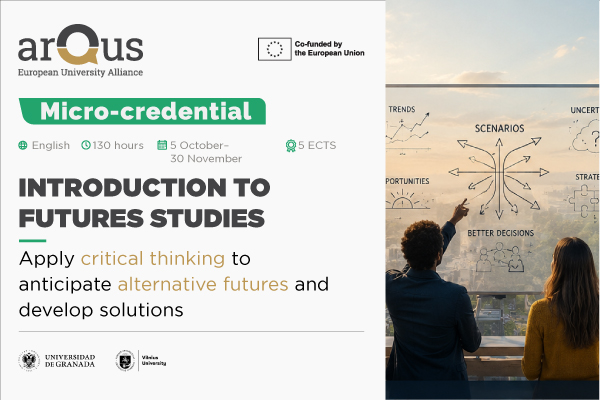
Introduction to Futures Studies micro-credential

The aim of the Introduction to Futures Studies course is to develop the student’s frame of mind to work with the future.

The UN Pact for the Future and related agenda documents frame futures studies, or strategic foresight, as a component of anticipatory governance, encouraging states to institutionalise periodic futures exercises across levels of government; within Europe, the Better Regulation framework, the European Commission’s foresight reports, and OECD guidance similarly mainstream foresight in public decision-making. UNESCO further promotes Futures Literacy as a key capability for navigating twenty-first-century challenges.

In parallel, foresight units and programmes have proliferated across several European countries, while large corporations and consultancies increasingly embed foresight into strategic planning, signalling a broad and sustained demand. Unfortunately, courses that introduce and develop futures studies remain scarce. This course is designed to address this educational gap.

Learning outcomes

  • Demonstrates knowledge of the basic concepts and terminology of futures studies
  • Is able to make a distinction among forecasting, foresight and anticipation, as well as an understanding of the main psychological and social biases that obstruct our future-orientation
  • Main properties of the future – The difference between „future“ and „futures“
  • Demonstrates holistic understanding of trends, megatrends and countertrends
  • Able to think creatively and use imagination: phases of a future exercise
  • Able to think critically: apply critical thinking by combining knowledge from different disciplines to anticipate alternative futures and develop proposed solutions
  • Demonstrates Futures literacy capabilities

Target audience profile

The micro-credential is designed for lifelong learners from any industry, profession or country

Fee of the micro-credential

600€

Admission requirements

Applicants must have English language proficiency at a minimum intermediate level (B1) – be able to study, communicate, and complete tasks without major language barriers.

Teaching dates

5th October, 2026 – 30th November, 2026

Mode of delivery

Online

Workload, teaching strategies, assessments and ECTS

The hours and workload involved (130 hours: 44 contact and 86 independent work hours) in this micro-credential are recognised as 5 ECTS.

Teaching and learning methods:

  • Lectures, speculative games, readings, discussions, problem based projects, reflections

Assesment methods:

  • Evaluation of the reflection on the content read in the Virtual Learning Platform (VLP)
  • Evaluation of the Global Developments Overview Report
  • Self-reflection assessment
  • Individual project
  • Evaluation of the final project

Language(s) of instruction

English

Participating institutions

Vilnius University (as coordinating University) and University of Granada. Also, Fondazione Italiana per gli studi di futuro ETS and Business Partner FIBRES Online Ltd are collaborating partners of this micro-credential.

Programme directors

Coordinating:

Erika Vaiginiene (PhD) is an associate professor at Vilnius University Faculty of Economics and Business Administration. She is a Foresight Strategist & Researcher, Change Management and Strategic Management professional, and Policy Maker with 25+ years of experience working in synergy with the academic and business worlds. Her purpose is to drive innovation and shape the future by leveraging research, analytics, and strategic foresight to positively impact business, society, and individuals. I embody this purpose through honesty, fairness, responsibility, and strong commitment. Erika’s passion for research led her to a PhD and deep expertise in both quantitative and qualitative methods, which she applies to high-impact consulting in innovation, entrepreneurship, and policy-making (e.g., strategic foresight: DESY (Germany), strategic projects at Vilnius University, identification of scientific priorities for VMU Agro-Innovation Park, etc.). Recognising the rising importance of foresight, she immersed herself in foresight methodologies at leading global institutions, later contributing as a methodologist to Lithuania 2050 and founding the Millennium Project’s Lithuania node. Erika holds multiple international memberships and certifications, including EFMD-certified Research Manager, FIBAA accreditation expert, and Adizes Change Management Integrator. She is a member of the Academy of Management, European Foresight Network, and the Association of Professional Futurists.

Others:

Alberto Bueno is Associate Professor of Political Science at the University of Granada (Spain), a member of the Spanish Research Group on Defence, Armed Forces, and Society (RODAS) and the Spanish Foresight Association. His research and teaching focus on security and defence policy, strategic analysis, and strategic foresight. He has contributed to several foresight-oriented projects and studies, including Panorama of Geopolitical Trends, Horizon 2040 (Spanish Ministry of Defence), Future Operating Environment, and the Hybrid Warfare Operational Concept (Spanish Army), while also teaching foresight and intelligence analysis at the postgraduate level and delivering seminars for public and private-sector organisations. Drawing on extensive experience with methods such as horizon scanning, trend and driver analysis, Delphi studies, backcasting, and scenario development, he combines academic research with practical foresight applications to help organisations and decision-makers navigate uncertainty, anticipate emerging challenges, and develop more robust strategies for the future.

Roberto Poli (PhD Utrecht) was a Professor of Philosophy of Science at the University of Trento (Italy). Poli leads the UNESCO Chair on Anticipatory Systems; he teaches Social Foresight and Epistemology of the Social Sciences and directs the Master’s in Social Foresight. Poli is a fellow of the STIAS — Stellenbosch Institute for Advanced Study. He is the President of AFI-Association of Italian Futurists, and Skopìa, a company offering professional anticipation services. Poli belongs to the editorial committees of many journals (including Futures and European Journal of Future Research). Poli has published 7 volumes; the last being Working with the future, Milan, Bocconi University Press, 2019. He is editor-in-chief of the Handbook of Anticipation (Springer). Poli has edited more than 20 journal volumes or special issues and published more than 250 scientific papers. He is an editor of the Handbook of Futures Studies.

Contact email address for applicants’ enquiries

  • Administrative contact: Rasa Makaveckiene – rasa.makaveckiene@vm.vu.lt
  • Academic contact: Prof. Erika Vaiginiene – erika.vaiginiene@cr.vu.lt
Call published on 31 Jul 2026
Newsletter

Don’t miss any news, calls or opportunities from Arqus.
Subscribe now! The future begins today.

    Subscribe


    You can change your mind at any time by clicking the unsubscribe link in the footer of any email you receive from us.

    We use Mailchimp as our marketing platform. By clicking below to subscribe, you acknowledge that your information will be transferred to Mailchimp for processing. Learn more about Mailchimp's privacy practices here.

    Controller: University of Granada (as Coordinator of the Arqus European University Alliance). Legal basis: Arqus is entitled to process your data under the provisions of Article 6.1. (a) of the GDPR: “the data subject has given consent to the processing of his or her personal data for one or more specific purposes”. Purpose: to manage your subscription to mailing lists and to periodically send you the requested information by electronic means. Recipients: Mailchimp. Rights: access, object, rectification, erasure, restriction of processing, data portability. Additional information here.

    Select our profile:

    Apart from the general information, what specific news would you like to receive from Arqus?

    Controller: University of Granada (as Coordinator of the Arqus European University Alliance). Legal basis: Arqus is entitled to process your data under the provisions of Article 6.1. (a) of the GDPR: “the data subject has given consent to the processing of his or her personal data for one or more specific purposes”. Purpose: to manage your subscription to mailing lists and to periodically send you the requested information by electronic means. Recipients: Mailchimp. Rights: access, object, rectification, erasure, restriction of processing, data portability. Additional information here.

    Arqus
    Privacy Overview

    This website uses cookies so that we can provide you with the best user experience possible. Cookie information is stored in your browser and performs functions such as recognising you when you return to our website and helping our team to understand which sections of the website you find most interesting and useful.