Sustainable modular housing systems I: A multi-perspective approach micro-credential
Beyond buildings: Creating resilient and smarter housing through multidisciplinary innovation.
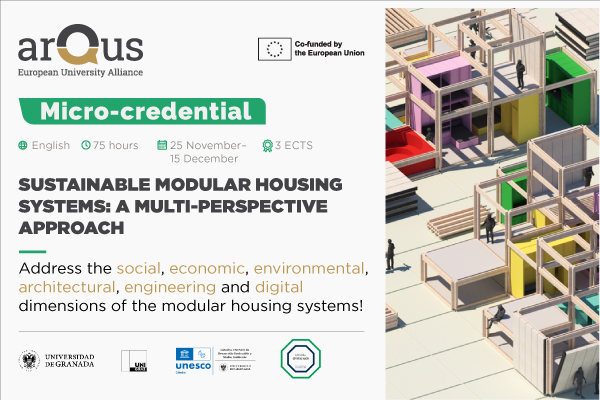
This microcredential explores sustainable modular housing systems from a multidisciplinary perspective, addressing their social, economic, environmental, architectural, engineering and digital dimensions. It covers the social, environmental, technological, architectural and governance dimensions of modular housing, including community participation, resource optimisation, LCA and Social LCA, social inclusion, data-driven design, parametric modelling, AI, Off-Site Construction, MMC, DfMA, urban integration and user-centred design.
It provides foundational tools for developing sustainable design and policy proposals and serves as the first stage of a stackable pathway leading to a more applied second micro-credential.
The programme also addresses collaborative governance, public-private partnerships, sustainable financing, SDGs 11 and 17, social enterprises, smart-city initiatives and inclusive, resilient housing ecosystems. Teaching is online and student-centred, combining interactive lectures, problem-based learning, collaborative projects, online discussions, case studies and mentoring. Assessment includes individual reflection, group project work, online participation and a final presentation or portfolio.
Provide a comprehensive understanding of the global context of sustainable and modular housing
Promote a multidisciplinary and international approach to sustainability challenges in the industrialised housing sector
Integrate knowledge and methods from Sociology, Economy, Computer Science, Artificial Intelligence, Architecture and Engineering
Equip students with foundational concepts and analytical tools for developing design and policy proposals
Lay the groundwork for the applied and practice-oriented work to be carried out in MC2
Learning outcomes
Analyse global challenges and opportunities in sustainable modular housing
Integrate diverse disciplinary perspectives
Apply theoretical and analytical tools
Design collaborative, research-based projects
Communicate and collaborate effectively within international, multidisciplinary teams
Target audience profile
Graduates and undergraduates from a wide range of academic backgrounds are encouraged to apply, including Environmental Studies, Business Administration, Economics, Geography, Mathematics, Computer Science, Programming, Architecture and Sociology. Learners from technical disciplines, particularly Engineering and Architecture, are especially welcome because their expertise can enrich the collaborative and multidisciplinary learning environment.
Admission requirements
No specific formal admission requirements are stated beyond the mentioned target academic profile.
Teaching dates and hours
25 November – 15 December 2026
Mode of delivery
Online format
Number of ECTS
3 ECTS. Total student workload: 75 hours, including 30 contact hours and 45 independent work hours.
Language(s) of instruction
English
Participating institutions
University of Granada (coordinator) and University of Graz
Teaching staff involved
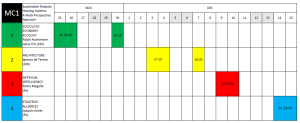
Coordination: Mercedes García de Quesada (University of Granada)
Module on Sociology, Economy and Ecology: Ralf Aschemann and Julius Ott (University of Graz)
Module on Architecture: Ignacio de Teresa (University of Granada)
Module on Artificial Intelligence: Pedro Javier Magaña (University of Granada)
Module on Strategic Alliances: Joaquín Avilés López (UNESCO Chair at the University of Granada, external collaborator)
Contact person
Do you have any questions? Please email:
Prof. Mercedes García de Quesada. Associate Professor and Head of the
Department of Translation and Interpreting at the University of Granada
(UGR): gquesada@ugr.es