
Online VISURB open lecture on visual research methods organised by the University of Wrocław
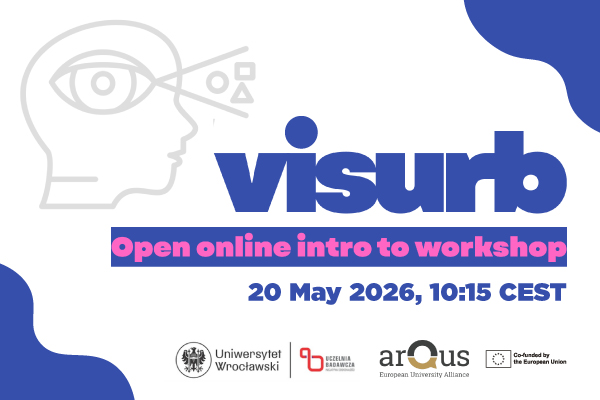
20 MAY2026

Type: Communities of Practice

Format: Online

Open to: General public

Arqus invites participants from across its partner institutions and beyond to attend an open online lecture the VISURB Workshop “Images in transformation: Visual techniques in research on the experience of spatial change”.

The session will take place on 20 May 2026 (Wednesday), from 10:30 to 12:30 (CEST) via MS Teams. Participation is free, but prior registration is required. Hosted in Wrocław, the lecture forms part of the broader VISURB Workshop running from 20–22 May within the ExNUrb Community of Practice under Arqus.


Exploring visual methods in spatial research

The open lecture will be delivered by Maciej Frąckowiak and Łukasz Rogowski from Adam Mickiewicz University. It offers an introduction to key theoretical and methodological approaches in visual research, particularly in the context of studying spatial transformation and urban experience.
Participants will gain insights into:

  • The theoretical foundations of visual research, including the academic traditions where these approaches are most effective
  • Core principles of selected visual research techniques, such as:
  1. Observation
  2. Photo diaries
  3. Photo-elicitation interviews
  4. Walking-with-video methods

About the speakers

Maciej Frąckowiak is a sociologist and assistant professor at the Faculty of Sociology at Adam Mickiewicz University, as well as a lecturer at SWPS University in Warsaw. His research focuses on culture and the city, particularly the sociology of architecture and spatial planning.

Łukasz Rogowski, also a sociologist and assistant professor at the same faculty, specialises in visual culture, visual research methodologies, the sociology of the internet, mobility and sociological theory.


This session provides a valuable opportunity for researchers, students, and practitioners to deepen their understanding of visual methodologies and their application in analysing urban and spatial change – an increasingly relevant topic across disciplines within Arqus.

Newsletter

Don’t miss any news, calls or opportunities from Arqus.
Subscribe now! The future begins today.

    Subscribe


    You can change your mind at any time by clicking the unsubscribe link in the footer of any email you receive from us.

    We use Mailchimp as our marketing platform. By clicking below to subscribe, you acknowledge that your information will be transferred to Mailchimp for processing. Learn more about Mailchimp's privacy practices here.

    Controller: University of Granada (as Coordinator of the Arqus European University Alliance). Legal basis: Arqus is entitled to process your data under the provisions of Article 6.1. (a) of the GDPR: “the data subject has given consent to the processing of his or her personal data for one or more specific purposes”. Purpose: to manage your subscription to mailing lists and to periodically send you the requested information by electronic means. Recipients: Mailchimp. Rights: access, object, rectification, erasure, restriction of processing, data portability. Additional information here.

    Select our profile:

    Apart from the general information, what specific news would you like to receive from Arqus?

    Controller: University of Granada (as Coordinator of the Arqus European University Alliance). Legal basis: Arqus is entitled to process your data under the provisions of Article 6.1. (a) of the GDPR: “the data subject has given consent to the processing of his or her personal data for one or more specific purposes”. Purpose: to manage your subscription to mailing lists and to periodically send you the requested information by electronic means. Recipients: Mailchimp. Rights: access, object, rectification, erasure, restriction of processing, data portability. Additional information here.

    Arqus
    Privacy Overview

    This website uses cookies so that we can provide you with the best user experience possible. Cookie information is stored in your browser and performs functions such as recognising you when you return to our website and helping our team to understand which sections of the website you find most interesting and useful.