
Format: Online
Open to: Academics & researchers, Teachers
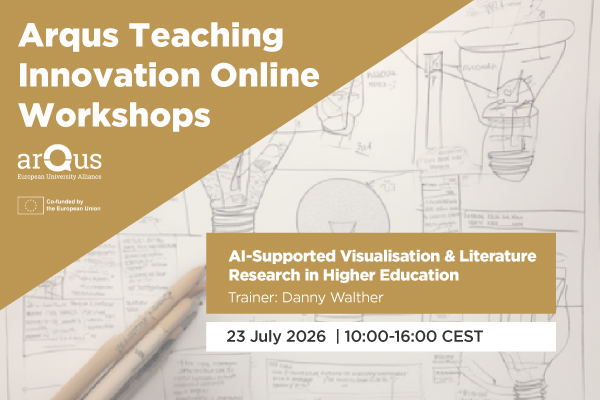
This online workshop, which will take place on 23 July from 10 to 16h CEST, will combine two core competencies for modern higher education: the visual presentation of complex content using AI tools and AI-supported literature research.
The workshop will be organised via Zoom as a single session divided into two parts, with a break in between:
Visualisations are a central element of effective university teaching. They structure complex content, support comprehension, and play a key role in science communication. The first part of the workshop will explore how AI tools can help educators create high-quality visual teaching materials that can be adapted to specific teaching contexts. All tools presented will be either open source or available free of charge. No prior technical knowledge is required.
This part will focus on AI-supported literature research and the visual exploration of research landscapes. Many current research tools offer integrated visualisation features, ranging from citation networks and authorship maps to thematic clustering of literature corpora. These tools make it possible to map scientific fields at a glance and identify gaps in existing knowledge.
After an introduction to a systematic research workflow, participants will test free AI tools live, including one that can automatically detect hallucinated sources. The session will also address broader questions: How is AI changing academic research? What does information literacy look like in the age of AI?
Throughout, the focus will stay on transfer to participants’ own teaching, particularly in two areas of pressing current need: guiding students in conducting well-founded literature research, and strengthening their information literacy in working with AI. They will work out concretely how teachers can support students in carrying out methodologically sound, transparent searches, critically evaluating sources, and using AI tools reflectively, including how to recognise and verify hallucinated sources. Participants will leave with adaptable teaching-learning scenarios for their own disciplines.
After the workshop, participants will be able to:
Danny Walther, M.A., works as a freelance lecturer at universities, research institutions, and educational organisations. His areas of expertise include data and literature research, visualisation methods, and the use of AI in academia and higher education. He develops AI literacy programmes in collaboration with universities and leads workshops on a practice-oriented and evidence-based use of AI.
To register, please send an email to: mandi.strambowski@uni-leipzig.de. You will then receive the Zoom link for the event.
