
Type: Arqus Teaching Innovation
Format: Online
Open to: Academics & researchers, Teachers
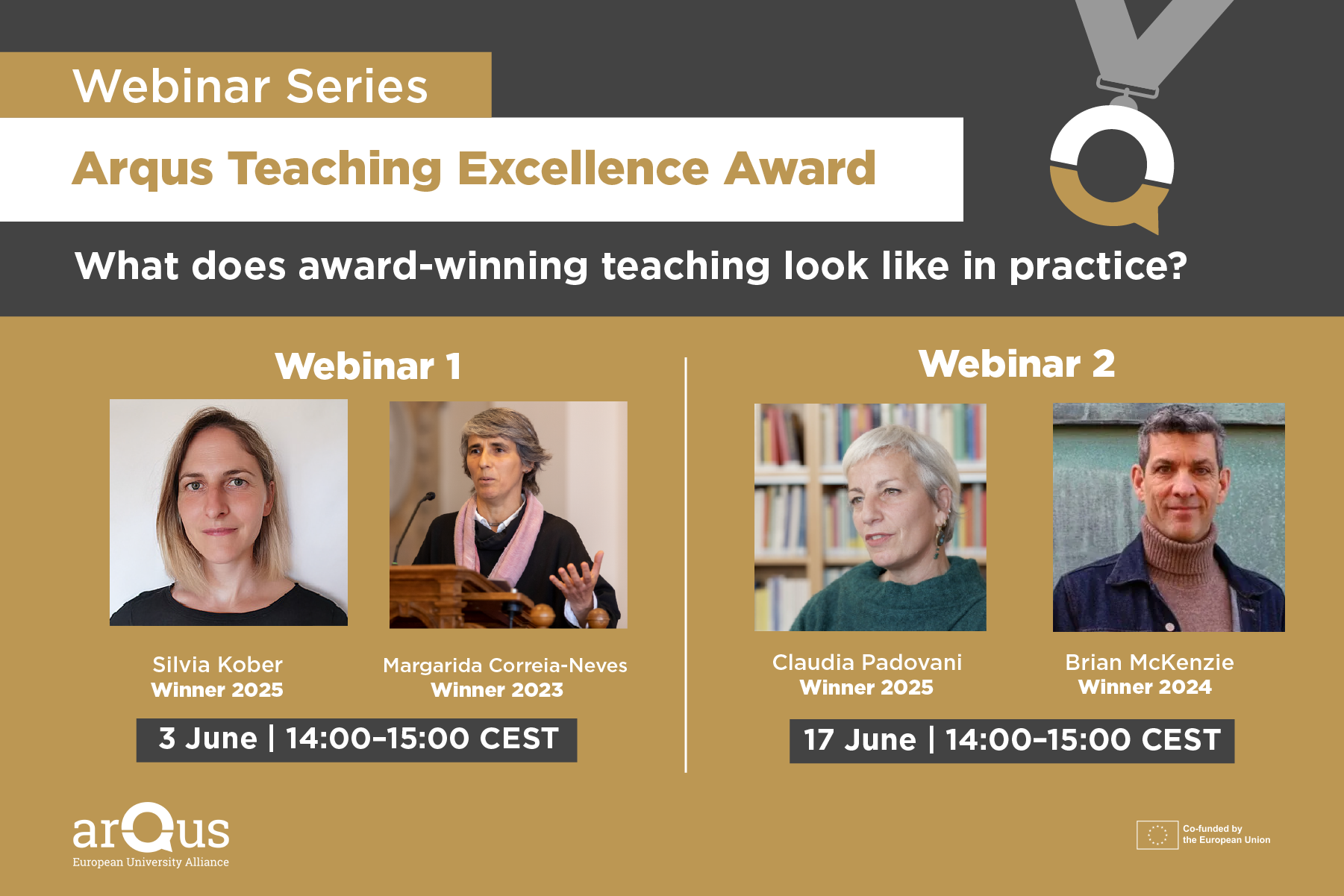
What does award-winning teaching look like in practice? The new “Arqus Teaching Excellence Award Webinar Series” will bring together teaching staff, educational support professionals and didactic experts from across Europe to explore innovative approaches to teaching and learning in higher education.
The online series will feature recipients of the Arqus Teaching Excellence Award from different editions between 2021 and 2026. In each 60-minute session, two award winners will present their teaching projects, share methodologies and good practices, and engage in discussion with participants through interactive Q&A breakout rooms.
Reflecting the diversity of Arqus, the webinar topics will cover a wide range of disciplines, pedagogical approaches and educational objectives, showcasing inspiring examples of excellence and innovation in university teaching.
The webinars aim to provide participants with practical ideas and transferable experiences to enrich teaching, learning and assessment practices in their own contexts.
The first sessions will take place from 14:00 to 15:00 CEST.
First webinar session – 3 June 2026
Silvia Kober – University of Graz
Course: Applied neuropsychology in human-computer interaction
Arqus Teaching Excellence Award Winner 2025
In a short presentation, Silvia Kober will give insights into the course she developed for Master’s students in the two study fields of Psychology at the University of Graz and Computational Social Systems (CSS), which is a master’s degree program offered jointly by the University of Graz and the Graz University of Technology.
The aim of the course is to expand the theoretical and practical knowledge about human-computer interaction systems on a multidimensional level and to enhance the students’ critical thinking in this context, enabling responsible use of this technology and contributing to its further development in the future. Learning outcomes focus on fostering communication, collaboration, creativity, and critical thinking. By combining theoretical knowledge with hands-on experience, students engage critically with both the benefits and potential risks of these technologies, including emerging issues like neurorights.
Margarida Correia-Neves – University of Minho
Course: Humanitarian Medicine – Thinking Global, Acting Local
Arqus Teaching Excellence Award Winner 2023
In her presentation, Margarida Correia-Neves will give insights in the course she developed together with her colleagues. Under the motto “For a more humane medicine”, it integrates aspects of humanitarian medicine, humanism in health and human rights into the Master’s Programme in Medicine offered by the University of Minho.
The training equips students with the knowledge and skills needed to act in a global and intercultural world – both at the doorstep within each one’s health facility and in humanitarian missions nationally and abroad. It offers an overall understanding of diverse cultures enhancing students’ to provide health care with equity according to the cultural singularities of each patient.
Second webinar session – 17 June 2026
Brian McKenzie – Maynooth University
Course: Universal Critical Skills/Data Literacy for Arts Students
Arqus Teaching Excellence Award Winner 2024
The session will present innovative approaches to strengthening data literacy and critical skills among Arts students through interdisciplinary and inclusive teaching practices.
Claudia Padovani – University of Padua
Course: Communication practices diversity and inclusion
Arqus Teaching Excellence Award Winner 2025
In her presentation, Claudia Padovani will give insights int the course “Communication practices diversity and inclusion”, which has been offered at the University of Padua since 2020, as a compulsory course in the English curricula of the Communication Strategy degree. The course offers opportunities to explore the intersection of media, communication, and democratic principles such as access, inclusion, participation, pluralism, and equality.
Students gain awareness of current debates concerning global communications – including news media, traditional and digital, ICT and digital platforms – and their social implications in relation to the needs and capacities of different social groups, including women and LGBTQI+ communities, ethnic minorities and indigenous peoples. Through interactive learning, group projects, and international collaborations, students develop transversal skills, including public speaking, intercultural communication, and critical analysis.
Further information about the Arqus Teaching Excellence Award winners is available here.