Applications open for the micro-credential on science and scholarly communication

Arqus

|

03 Nov 2026
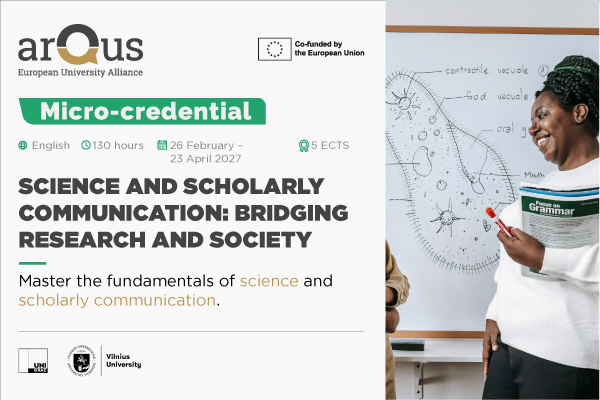
Applications are officially open for the new Arqus micro-credential “Science and Scholarly Communication: Bridging Research and Society”, offered jointly by the University of Graz and Vilnius University. Students, researchers and lifelong learners across the Alliance are invited to submit their applications by 1 February.

Designed to help participants bridge the gap between academic research and public engagement, this online micro-credential provides a comprehensive overview of the scholarly publishing ecosystem, open science practices, and effective public communication strategies.

Why join this programme?

In today’s fast-evolving academic landscape, making research accessible, transparent, and engaging is key. Through a blend of theoretical insights and practical, hands-on tasks, learners will acquire the tools to:

  • Navigate the academic publishing lifecycle and apply Open Science principles (FAIR data, open licensing).
  • Translate complex scientific findings into engaging formats, such as lay summaries, press releases, social media content, and visual stories.
  • Develop an end-to-end communication strategy for research projects.
  • Complete a capstone project delivering both a scholarly output and a tailored public communication deliverable.

Key details and eligibility

  • Target Audience: Arqus Bachelor’s and Master’s students, as well as lifelong learners interested in research and academic communication
  • Format: Online
  • Dates: running from 26 February to 23 April 2027
  • Free of charge for Arqus degree students (€500 for external lifelong learners)
  • Application period open from 1 November 2026 to 1 February 2027

Led by programme directors Vincas Grigas (Vilnius University) and Hildrun Walter (University of Graz), both active Open Science Ambassadors within Arqus Alliance, this course offers an exceptional opportunity to learn directly from leading experts in digital publishing and science communication.

Don’t miss the chance to boost your academic and communication skill set!
Newsletter

Don’t miss any news, calls or opportunities from Arqus.
Subscribe now! The future begins today.

    Subscribe


    You can change your mind at any time by clicking the unsubscribe link in the footer of any email you receive from us.

    We use Mailchimp as our marketing platform. By clicking below to subscribe, you acknowledge that your information will be transferred to Mailchimp for processing. Learn more about Mailchimp's privacy practices here.

    Controller: University of Granada (as Coordinator of the Arqus European University Alliance). Legal basis: Arqus is entitled to process your data under the provisions of Article 6.1. (a) of the GDPR: “the data subject has given consent to the processing of his or her personal data for one or more specific purposes”. Purpose: to manage your subscription to mailing lists and to periodically send you the requested information by electronic means. Recipients: Mailchimp. Rights: access, object, rectification, erasure, restriction of processing, data portability. Additional information here.

    Select our profile:

    Apart from the general information, what specific news would you like to receive from Arqus?

    Controller: University of Granada (as Coordinator of the Arqus European University Alliance). Legal basis: Arqus is entitled to process your data under the provisions of Article 6.1. (a) of the GDPR: “the data subject has given consent to the processing of his or her personal data for one or more specific purposes”. Purpose: to manage your subscription to mailing lists and to periodically send you the requested information by electronic means. Recipients: Mailchimp. Rights: access, object, rectification, erasure, restriction of processing, data portability. Additional information here.

    Arqus
    Privacy Overview

    This website uses cookies so that we can provide you with the best user experience possible. Cookie information is stored in your browser and performs functions such as recognising you when you return to our website and helping our team to understand which sections of the website you find most interesting and useful.