Arqus Talent Scholarship recipient Jonas Žurauskas publishes research in leading chemistry journal
Arqus
|
13 Oct 2026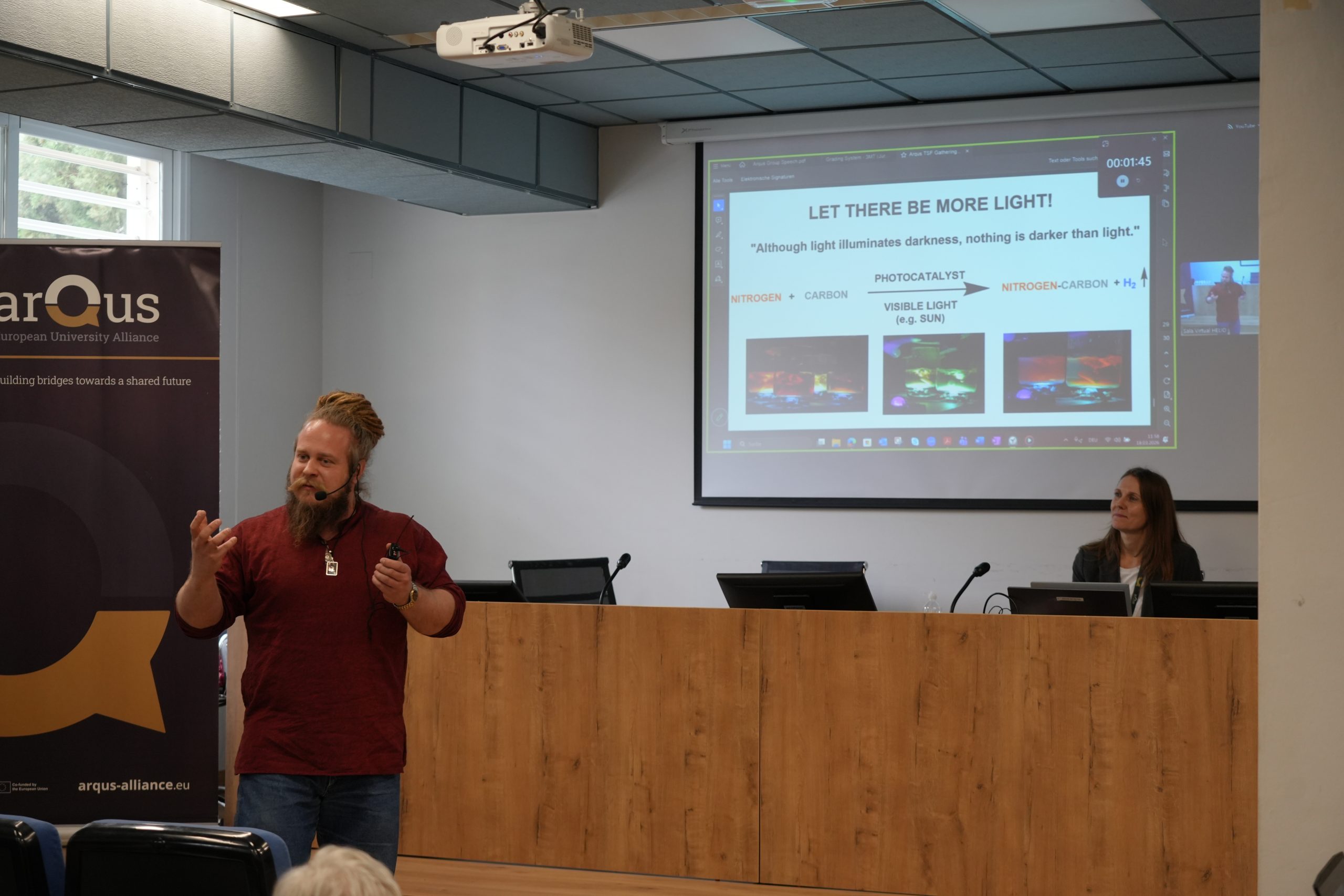
|
13 Oct 2026The Vilnius University PhD candidate is the first author of a study published in the Journal of the American Chemical Society, introducing a new light-driven method for modifying molecules in a single step.
Jonas Žurauskas, a PhD candidate at Vilnius University and a recipient of support from the Arqus Talent Scholarship Fund, has published a research paper in the Journal of the American Chemical Society (JACS), a leading international journal in chemistry. The study presents a new way to modify certain molecules using visible light, offering a potentially more efficient approach to preparing compounds for further chemical research.
Aromatic compounds are an important part of many substances we encounter in everyday life, including medicines, dyes and plastics. Their molecular structure makes them particularly stable, which is useful in finished products but can make them difficult to modify when developing new compounds. Introducing a new component into these molecules can require several preparatory steps, consuming time, materials and solvents.
In their study, researchers at Vilnius University developed a method that uses visible light to introduce a carbon-based fragment directly into certain aromatic compounds in a single step. The process combines a light-sensitive catalyst with a specially designed chemical reagent. When exposed to visible light, the catalyst activates the reagent, enabling the reaction that attaches the new fragment to the molecule.
Small changes in a molecule can significantly affect its chemical properties and biological activity. In drug discovery, for example, researchers often modify the structure of candidate compounds to investigate how these changes influence their potential as medicines.
The method developed by the Vilnius University team offers chemists another way to make such modifications, potentially reducing the number of steps needed to prepare certain compounds. The carbon-based fragment introduced during the reaction can also serve as a starting point for further chemical changes, enabling researchers to explore different molecular structures from the same starting material.
By providing a new approach to modifying aromatic compounds, the method could become a useful tool for researchers exploring new molecules and their potential applications, including in medicinal chemistry.
The research was carried out by a team at Vilnius University, highlighting the contribution of its research community to advances in chemistry. It is also an opportunity for Arqus to celebrate the achievements of a young researcher supported by the Arqus Talent Scholarship Fund and to highlight the value of investing in emerging scientific talent.
Reflecting on the research, Jonas Žurauskas highlighted the importance of finding simpler ways to make complex molecules:
“Chemists have known for a long time which molecules they would like to make; the difficulty is usually the number of steps it takes to get there. What visible light gives us is a gentler way to activate otherwise unreactive bond, so that a change which used to take many steps can be made in one. I am grateful to the Arqus Talent Scholarship Fund for supporting this work, and to my colleagues in Vilnius, several of whom are still students and who carried a great deal of it.”
The paper, entitled “A Photoredox C–H Arene Functionalization toward Substituted Methyls”, is published open access, making it freely available to readers.
Read the full research paper: A Photoredox C–H Arene Functionalization toward Substituted Methyls
Reference: Žurauskas, J.; Radzevičius, N.; Vaickūnas, P.; Sergejevaitė, G.; Orentas, E. “A Photoredox C–H Arene Functionalization toward Substituted Methyls.” Journal of the American Chemical Society (2026), 148 (28), 29876–29882. https://doi.org/10.1021/jacs.6c04756