Arqus Joint Master in Translation, Technologies and Artificial Intelligence receives accreditation
Arqus
|
30 Sep 2026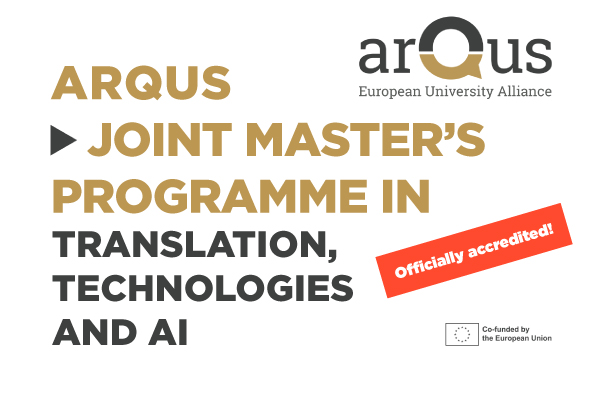
|
30 Sep 2026The Arqus Joint Master’s Programme in Translation, Technologies and Artificial Intelligence has been officially accredited without any conditions by the Agency for Quality Assurance and Accreditation Austria, marking an important milestone in the development of this new joint degree within Arqus.
The programme, jointly offered by the University of Graz, the University of Granada, the University of Minho and Vilnius University, will welcome its first cohort of students in autumn 2027.
The two-year programme comprises 120 ECTS credits and is designed for students seeking to specialise in translation and interpreting in an increasingly digitalised world, as well as for those interested in research at the intersection of translation, technology and artificial intelligence.
Drawing on the complementary expertise of the four partner universities, the programme combines an interdisciplinary and international curriculum covering translation, translation technologies and artificial intelligence. Students will explore the growing demand for multilingual communication while examining how rapidly evolving technologies, including machine learning and AI, are transforming translation and interpreting practices.
The programme also places particular emphasis on the critical evaluation of computer- and AI-supported technologies, workflows and institutional conditions, equipping students to understand not only the opportunities offered by these technologies but also the challenges involved in their implementation.
Mobility is a central component of the joint degree. To obtain the joint qualification, students will complete at least 30 ECTS credits through physical mobility at a member university other than their entrance university during the second or third semester. Students are also strongly encouraged to undertake a second mobility experience.
In addition, 30 ECTS credits will be completed through joint components offered by all four partner universities, delivered online, in blended or hybrid formats. This structure enables students to benefit from the academic expertise and learning environments of the four institutions while building an international profile throughout their studies.
Students can enter the programme through the University of Graz, the University of Minho or Vilnius University, with mobility pathways involving the four partner institutions:
Throughout the programme, students will develop knowledge and practical skills to design and implement computer- and AI-supported translation workflows and contribute to effective and inclusive communication across linguistic and cultural boundaries.
Graduates will be prepared to work in interdisciplinary environments as specialists in areas including digital and AI-supported translation, multilingual project management and AI integration strategies and policies. The programme will also address areas such as AI-related risk assessment, the sustainable integration of digital technologies and machine learning, and the development of new language-technology solutions.
By bringing together four Arqus universities and combining expertise from translation studies, language technologies and artificial intelligence, the programme responds to the changing professional and research landscape of multilingual communication.
Following its accreditation, the Arqus Joint Master’s in Translation, Technologies and Artificial Intelligence is now moving towards its first student intake, with the first cohort scheduled to begin in autumn 2027.
More information about the programme and the application process will be available soon through the partner universities and this website.
With this new programme, Arqus expands its portfolio of joint degree programmes to five. In addition, the Arqus Joint Bachelor’s Degree in Physics for Technology is currently undergoing accreditation by the Lithuanian Quality Agency, while the Arqus Joint Master’s Programme in Environmental and Energy Law: Technology, Security and Sustainability is currently under development.