Interview with researcher Rascha Albaba Acosta to mark Europe Day
Arqus
|
09 May 2026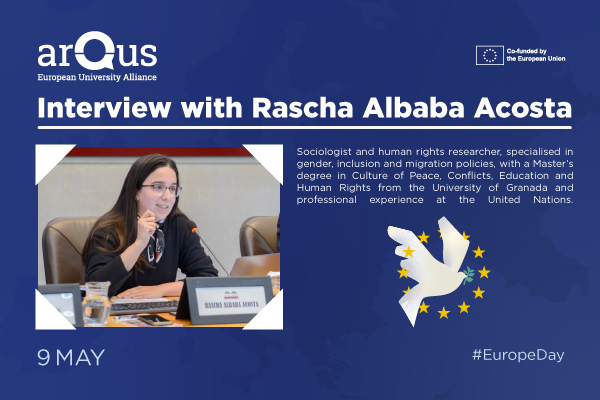
|
09 May 2026To mark Europe Day on 9 May, we have launched a series of interviews with leading researchers and experts on European affairs, inviting them to reflect on the current situation facing our continent. At a time shaped by geopolitical tensions, social uncertainty and major global challenges, these conversations aim to provide insight and critical perspectives on Europe’s present and future.
In this second interview of the series, we speak with Rascha Albaba Acosta, who holds a Master’s Degree in Culture of Peace, Conflicts, Education and Human Rights, as well as a Bachelor’s degree in Sociology from the University of Jordan. She has more than seven years of professional experience in the field of human rights, including five years working with the United Nations in Jordan. Her expertise focuses on gender, inclusion and violence prevention, alongside the implementation and monitoring of international human rights mechanisms.
During her time in Jordan, she worked on the response to the Syrian refugee crisis and served as the gender focal point within the gender-based violence working group coordinated by the United Nations. Currently, her research explores discrimination, hate speech and extremism in Europe from a human rights and intersectional perspective, with particular attention to migration externalization policies and refugee management in Europe. Her master’s thesis, titled Between Policy and Reality: Building Resilience in the EU and Among Syrian Refugees in Jordan, examined the gap between European policy frameworks and the lived experiences of displaced communities.
From my experience at the Euro-Arab Foundation for Higher Studies here in Granada, where we work on research projects addressing discrimination, hate speech, and extremism, defending peace and human rights is not a choice—it is an ethical and professional responsibility that runs through everything we do.
In my day-to-day work, I see that hate is not an abstract concept, but a reality that directly affects people and communities. That is why our work focuses on something quite specific: generating rigorous research that can be used to improve public policy and strengthen the institutional response to these phenomena. Through European projects such as ECLIPSE, HATEDEMICS, PARTESS-COM, SHIELDed, VicTory, VIRTUOUS, we analyse how hate speech is evolving in Europe and Spain, develop practical tools for professionals and, above all, work to ensure that victims have access to information, support and spaces where their voices can be heard.
But beyond research, there is a fundamental human dimension. We work directly with public institutions, security forces, the criminal justice system, social organisations, the education sector, researchers, young people and the general community to improve support for victims through an approach based on human rights, victim-centred care and restorative justice, whilst preventing their revictimisation. We also help to protect places of belonging, such as places of worship, and promote campaigns that raise the profile of the most vulnerable communities and challenge deeply entrenched stereotypes.
Defending human rights is not a choice, it is a responsibility. It is a commitment to human dignity. International law not only recognises these rights, but also obliges us—especially those of us who work in the public sector—to protect them and ensure they are upheld. In an increasingly interconnected world, where people move and societies transform, human rights are the framework that protects our dignity, our diversity, our freedom and our ability to make decisions without undue interference. Human rights are what guarantee that all people, without exception, can live with dignity, freedom and autonomy.
Human rights are, moreover, the foundation of the rule of law: they establish that no one is above the law. They are the safeguard against the abuse of power. And precisely at a time when we are seeing attempts, in various contexts, to restrict or reinterpret these rights, their defence becomes not only necessary, but urgent.
For me, universality is not just a principle; it is the foundation of everything: rights should never depend on where you are. Articles 1 and 2 of the United Nations Universal Declaration of Human Rights make this clear: all human beings are born free and equal in dignity and rights. And Article 29 adds a key element: rights entail responsibilities. It is only within a community that we can fully exercise them, whilst always respecting the rights of others and the principles of a democratic society. That is why defending them is not just the task of states, but a shared responsibility. Much remains to be done. But I believe deeply in the power of dialogue, in mutual understanding and in the need to create spaces where all voices can be heard, to reinforce that shared responsibility and continue to make progress in better defending the rights of all people. It is precisely that conviction that led me to join the Euro-Arab Foundation.
Research is an essential part of defending human rights because it enables something basic yet crucial: bringing to light realities that would otherwise remain hidden. It is also a key tool for combating disinformation, which today fuels many forms of rights violations.
Through evidence, research places the facts at the centre of public debate and contributes directly to accountability. Without data, rigorous analysis and systematic documentation, many situations of violence, exclusion or discrimination would simply not be recognised or addressed.
A particularly significant example for me comes from my experience working with the United Nations Population Fund (UNFPA) in Jordan, on a study into so-called period poverty and women’s and girls’ access to menstrual hygiene products and information. The report highlighted how the lack of access to basic resources, adequate information and decent conditions particularly affects women and girls in vulnerable situations, including refugees, communities in rural areas and areas with limited services. This type of evidence helped to put the issue on the public agenda and strengthen recommendations aimed at improving policies and community responses in this area.
This work had a profound impact on me because it shows something very specific: when research connects with people lived experiences, it can become a turning point for change, not only at an institutional level, but also at a community level.
Furthermore, research plays a key role within international human rights mechanisms. Processes such as the United Nations Universal Periodic Review or the work of international committees rely heavily on solid evidence and rigorous documentation to formulate recommendations to States and assess their compliance.
Similarly, the United Nations special procedures draw on independent research that enables the documentation of rights violations in complex contexts and provides evidence for international action. An example of this that many readers will surely be familiar with is the work of Francesca Albanese— the Special Rapporteur on the situation of human rights in the Palestinian territory occupied since 1967— whose official reports, based on rigorous documentation, analysis of patterns of violence and the collection of evidence on the ground, have helped to systematise and highlight serious human rights violations, situating them within the framework of international law and generating key inputs for international accountability, which highlights the powerful role of investigation.
Finally, research has a value that I consider essential: amplifying the voices of those affected. It is not only about producing knowledge, but about creating spaces where these experiences can be heard, recognised, and taken into account. In that sense, conducting research is also a way of giving presence to those who have too often been silenced. And that, ultimately, is what makes research so decisive in the defence of Human Rights: it turns evidence into action and reality into shared responsibility.
When I think of Europe, I think of a deeply transformative project: a region that was able to rise from the devastation of war to build a space of peace, cooperation and shared values. The creation of the European Union is, without doubt, one of the greatest historical achievements in terms of stability, reconciliation and shared progress.
Europe has not only consolidated decades of peace between countries that were at odds for centuries, but has also built a model based on democracy, the rule of law and the protection of human rights. Added to this is the development of the single market and free movement policies that have expanded opportunities for millions of people, alongside mobility programmes, educational and scientific cooperation, and cohesion policies that have helped to reduce inequalities and strengthen a sense of European citizenship.
On a personal level, my relationship with Europe is also based on experience. As a European, Spanish and Jordanian, I have been able to experience first-hand what it means to live in a context where freedom, equality and the protection of rights are more firmly guaranteed. Although there are also significant freedoms in Jordan and significant progress is being made every day in the area of rights, the experience of equality before the law and its full consolidation is not the same. This comparative experience has led me to deeply appreciate what freedom truly means and its value, aware that, for many people in different contexts, exercising it still comes at a very high cost.
That is why, when we celebrate Europe, we must also do so with a critical awareness. In the current context, political polarisation, geopolitical tensions, disinformation, inequalities and multiple crises are testing the principles that have underpinned this project. Europe has been – and to a large extent remains – a global benchmark by demonstrating that it is possible to transform historical conflicts into cooperation and build peace through common institutions. But that peace is not a given: it is a process that requires constant defence.
Europe must continue to be a benchmark. But to do so, it is essential to actively protect its values, question its contradictions, and work collectively to ensure that peace, equality, and dignity are not just founding principles, but living, sustained realities.
Europe, and in particular the European Union together with its Member States, remains a key player in the multilateral system, especially within the United Nations, both in the General Assembly and in the Security Council, where European countries play an active role in shaping global peace and security agendas.
Its influence is expressed through its ‘normative power’, that is, its ability to set international standards in areas such as human rights, international law, climate, trade and digital governance. In this sense, Europe acts not only as a political and economic actor, but also as a regulatory and ethical benchmark within the international system.
However, in the current geopolitical context, this role faces growing tensions. In one respect, we have seen swift and coordinated European responses to certain conflicts, such as the war in Ukraine, across the political, humanitarian and economic spheres. Yet, at the same time, in other contexts of humanitarian crises and serious violations of international law, responses have been more fragmented or perceived as less consistent. This asymmetry gives rise to a legitimate debate about the coherence and universality of the principles that Europe upholds.
On top of that, there are internal challenges that have a direct impact on its international image. European migration policies, particularly since the 2015–2016 crisis, have shifted towards approaches that focus more on border control and externalisation, which has sparked a wide-ranging debate on the balance between migration management and the effective protection of the right to asylum. However, we continue to see this reflected in current measures. We are observing a shift in policies towards approaches more focused on control and the externalisation of migration management, including the strengthening of cooperation with third countries and recent debates surrounding proposals such as the so-called ‘Return Regulation’ in the European Parliament, which have reignited important discussions on the balance between migration management and the effective protection of human rights. Furthermore, the rise in disinformation, racism, hate speech and social polarisation within Europe is undermining internal cohesion and affecting the external credibility of the European project.
In this context, Europe needs to reaffirm itself. Not only as a space of rights internally, but also as a coherent actor externally. And this responsibility falls not only on the institutions, but also on the public. We cannot forget the path we have travelled or the struggles that made the freedoms we enjoy today possible.
At the same time, it is important to recognise that European civil society has become increasingly active and visible. In recent years, we have seen mass demonstrations in cities across Europe, awareness-raising campaigns, statements from universities and civil society organisations, and advocacy efforts in global contexts to defend human dignity and Human Rights.
A clear example is the case of Palestine, where civil society has maintained sustained mobilisation over time, including protests, boycott campaigns, academic initiatives, and statements from professional groups. Symbolic and political pressure actions have also emerged, such as solidarity flotillas, which have had significant media impact and contributed to raising awareness about the humanitarian situation and calling for greater consistency in the application of international humanitarian law. This type of mobilisation is not an isolated phenomenon, but reflects a broader trend towards an increasingly aware and active European public, which demands coherence in foreign policy and a more consistent defence of the values that Europe claims to represent.
On a personal level, there are several current trends that deeply concern me as a society. I am concerned, first and foremost, by the growing polarisation and the normalisation of hate speech, alongside the increasingly powerful impact of disinformation, which are fragmenting the public sphere and eroding our collective capacity for critical thinking.
I am equally concerned about the rise of individualism and the loss of a sense of collective responsibility. Human rights are not sustained solely by institutions, but by a shared culture based on empathy, solidarity and recognition of others.
Another aspect that particularly concerns me is the lack of consistency in the way women’s rights are defended globally. At times, the response is neither universal nor intersectional, and there is a perceived hierarchy of rights violations depending on the geopolitical context. This undermines the credibility of the commitment to gender equality: defending women’s rights means doing so in all contexts, without exception and without double standards.
I am also deeply concerned about the climate crisis and the lack of responses commensurate with the scale of the problem. Its impacts are neither future nor abstract, but present, and directly affect fundamental rights and existing inequalities.
And yet, despite all this, I remain hopeful.
I find it, quite specifically, in people. In those who work every day in research, education, the legal profession or activism to defend human rights. In a public that takes to the streets, that questions, that does not accept injustice as the norm. On the streets, in universities, in social organisations, and in all those forms of activism—whether high-profile or quiet—that continue to demand dignity and consistency.
I also find hope in those who break away from narrow perspectives and commit to more inclusive and intersectional approaches to human rights, understanding that equality cannot be selective nor dependent on context. For me, hope is not something abstract. It is a daily choice. It is choosing to get involved, to stay informed, not to look the other way, and to continue believing that even in very complex contexts it is possible to build fairer, more coherent and more humane societies.
You can read the other interviews of this Europe Day series here.