
English as a Medium of Instruction (EMI)

Arqus Plurilingual and Intercultural Hub

Many teachers working at Europe’s higher institutions of learning today are faced with new challenges as they begin to teach their core subjects in English. Successful classroom learning requires leadership and engagement that not only stimulates student participation but also facilitates comprehension. For these purposes, language teachers and academics engaged in EMI (English as Medium of Instruction) may wish to boost their own language skills and exchange ideas with international colleagues in the context of a virtual mobility.

The Arqus English-Medium Instruction (EMI) Community of Practice aims to broaden awareness of EMI across the Alliance, support colleagues already engaged in EMI, cultivate an active community of researcher-practitioners who explore developments in English as a Medium of Instruction and disseminate research and teaching innovation practices.

Get to know more the EMI CoP through their semi-annual newsletter: first issue (June 2025).

One of the Arqus English-Medium Instruction (EMI) CoP valuable activities is the EMI webinar series, aimed at Arqus educators and researchers already engaging or starting the process of engagement with English as a Medium of Instruction (EMI) in their institutions.

The 2024-25 edition was run by Maynooth University and titled Engaging with practice and research in English-Medium Instruction. It included 7 webinars and some of them can be watched on Arqus YouTube channel (links below). 

EMI Webinars

2025-26 (3rd edition)

2nd EMI webinar: Inclusive assessment in EMI: Linguistically accessible and diversified

Date: 11 December 2025
Time: 12:00 13:00 CET
Format: Online
Trainers: Alicia Salomone and Ludmila Kalasnikova.
Target Audience: Academics & researchers, admin. Staff, early post-docs

More information here

Summary: This webinar aimed to introduce “language-light” assessment approaches that are designed to reduce linguistic demands on EMI students while preserving content-focused academic standards. Participants explored practical alternatives to traditional written assignments and learned how small intentional adjustments can meaningfully enhance fairness and inclusion in EMI contexts.

Workshop Focus: The webinar provided concrete, adaptable techniques that educators can implement across a wide range of disciplines. By the end of the session, participants were encouraged to reflect on their own assessment practices and identify opportunities to design assessment tasks that are more accessible, equitable and linguistically inclusive.

1st EMI webinar: Assessment in English-Medium Instruction: Challenges, practices and collaboration

Date: 20 November 2025
Time: 12:00 13:00 CET
Format: Online
Trainer: Pınar Koçer
Target Audience: Academics & researchers, admin. Staff, early post-docs

More information here

Summary: This webinar sought to explore the complexities of assessing both content and language, outline the range of assessment practices observed across EMI contexts and discuss how collaboration between content lecturers and language specialists can promote fairness, transparency and validity in assessment design.

Workshop Focus: The seminar provided participants with an overview of the key principles, challenges and current debates surrounding assessment in English-medium instruction (EMI).

2024-25 (2nd edition)

#2 part 1 An overview of themes and research methods in EMI
#2 part 2 Navigating Multilingual Realities in Algerian Business Degree Programmes
#4 Advancing English-medium instruction research: quantitative methods and insights
#6 Affective factors and classroom interaction in a foreign language

7th EMI Webinar: Exploring input strategies and interaction in EMI Research: Insights from the Italian context

Date: 5 June 2025
Time: 13:30 – 14:30 (CEST)
Format: Online
Trainers: Francesca Costa (Catholic University of Sacro Cuore) and Cristina Mariotti (University of Pavia)
Target Audience: Students, academic and non-academic staff interested in EMI research

More information here

Summary:
This was the seventh (and last) event in its English-Medium Instruction (EMI) Seminar Series for 2024–25. This seminar aimed to reflect on the role of qualitative research in the context of EMI. The speakers presented a series of empirical studies conducted in Italian university settings as well as the edited volume Input in EMI, which brings together a variety of perspectives on this topic.

Workshop Focus:
The webinar guided the exploration of several interrelated topics: how lecturers present content to support comprehension, the role of questions in fostering interaction and critical thinking, the ways different disciplines shape input strategies, and the experiences of both local and international students in EMI settings.

6th EMI Webinar: Qualitative insights into EMI students’ experiences: Affective factors and classroom interaction in a foreign language

Date: 15 May 2025
Time: 12:00–13:00 CEST
Format: Online
Trainer:  Dr Marta Kopinska (University of the Basque Country)
Target Audience: Students, academic and non-academic staff interested in EMI research
Organised by: Arqus European University Alliance & Maynooth University
More information here.

Summary:
Drawing on her own and her colleagues’ recent qualitative research, Dr Marta Kopinska explored factors that lie behind EMI students’ (de)motivation to interact in class, as well as EMI-related anxiety. She also discussed some qualitative methods that were used to investigate these factors in the EMI setting and trace them over time.

Workshop Focus:
The webinar explored affective factors such as motivation and anxiety that might influence classroom interaction in EMI.

5th EMI Webinar: Academic intercultural (communicative) competence: Work in progress

Date: 17 April 2025
Time: 12:00–13:00 CEST
Format: Online
Trainer: Michael Byram (Durham University and Sofia University) and Lynne Parmenter, (Nazarbayev University, Kazakhstan)
Target Audience: Students, academic and non-academic staff interested in EMI research
Organised by: Arqus European University Alliance & Maynooth University
More information here.

Summary:
In this fifth event in 2024-25  English-Medium Instruction (EMI) seminar series, the speakers presented the view that working in a new academic environment involves much more than proficiency in the language of the environment. Whether the language is “the same” as that used by students in their familiar environment or different and “foreign”, they are bound to have new (academic) cultural experiences and draw on their intercultural competence.

Workshop Focus:
Participants will be introduced to a model of Academic Intercultural (Communicative) Competence and will learn about its implications for practice, including contexts of EMI.

4th EMI Webinar: Advancing English-Medium Instruction Research – Quantitative Methods and Insights

Date: 6 March 2025
Time: 12:00–13:00 CET
Format: Online
Trainer: Dr Samantha Curle (University of Bath)
Target Audience: Students, academic and non-academic staff interested in EMI research
Organised by: Arqus European University Alliance & Maynooth University
More information here.

Summary:
This fourth EMI webinar of the 2024-2025 Arqus series focused on advancing EMI research through quantitative methods. Drawing on her recently published book Researching English Medium Instruction: Quantitative Methods for Students and Researchers, Dr. Samantha Curle introduced participants to key concepts and tools for investigating EMI in higher education.

Workshop Focus:
The webinar explored how quantitative methods—including ANOVA, Likert-type surveys, and structural equation modelling (SEM)—can be used to study EMI practices, challenges, and outcomes. The trainer highlighted critical success factors such as content learning, English proficiency, and psychological constructs affecting EMI student performance.

Learning Objectives:

  • To understand key quantitative approaches for EMI research
  • To examine real-world EMI studies using these methods
  • To explore how quantitative analysis can inform EMI policy and practice
  • To reflect on how educators can conduct and apply their own research

Outcome:
Participants left with valuable tools for planning and conducting EMI-related research. The session bridged theoretical and practical insights, helping build capacity for evidence-based improvement of EMI teaching and learning.

3rd EMI Webinar: Using the ROAD-MAPPING Framework to Examine English-Medium Education in Multilingual Universities

Date: 20 February 2025
Time: 12:00–13:00 CET
Format: Online
Trainers: Prof. Emma Dafouz (Complutense University of Madrid) and Prof. Ute Smit (University of Vienna)
Target Audience: EMI educators, researchers, academic leaders
Organised by: Arqus European University Alliance & Maynooth University
More information here.

Summary:
This session—the third in the 2024–2025 Arqus EMI Webinar series—presented the ROAD-MAPPING framework for analyzing English-medium instruction (EMI) in higher education. The framework enables educators and policymakers to comprehensively evaluate EMI practices through the lens of inclusive internationalization and institutional diversity.

Workshop Focus:
Participants explored how the ROAD-MAPPING framework helps dissect linguistic, pedagogical, and institutional dimensions of EMI. The trainers shared practical applications of the model across multilingual university contexts, emphasising how it supports quality teaching, policy design, and global academic engagement.

Learning Objectives:

  • To understand the components of the ROAD-MAPPING framework
  • To analyse EMI contexts within and across diverse higher education institutions
  • To explore the impact of language policies on curriculum and pedagogy
  • To reflect on inclusive approaches to EMI program design

Outcome:
Attendees left with a powerful conceptual tool to inform research, program evaluation, and practice in EMI. The workshop emphasised the importance of aligning language and content goals in multilingual, internationalised educational settings.

2nd EMI Webinar: Research Themes and Methods in EMI – An Overview and an Example Study from Algeria

Date: 16 January 2025
Time: 12:00–13:00 CET
Format: Online
Trainers: Dr. Yulia Kharchenko (Maynooth University) and Sidi Ahmed Berrabah (University of Limerick)
Target Audience: EMI practitioners, researchers, and educators in multilingual contexts
Organised by: Arqus European University Alliance
More information here.

Summary:
This webinar, part of the 2024–2025 Arqus EMI Series, focused on current research themes and methods in English as a Medium of Instruction (EMI). It offered both a conceptual overview and a practical case study of EMI research in multilingual, post-colonial contexts, specifically Algeria.

Workshop Focus:
Participants explored major lines of EMI research and engaged with a real-world doctoral case study examining EMI implementation in Algerian business schools. The session provided an analysis of methodological strategies, including mixed-methods approaches, and introduced the concept of translanguaging as a teaching tool in linguistically diverse classrooms.

Learning Objectives:

  • To identify key research trends and methods in EMI
  • To understand how EMI is implemented in multilingual, post-colonial contexts
  • To explore the use of translanguaging in higher education
  • To reflect on methodology and positionality in EMI research

Outcome:
Participants deepened their understanding of how EMI practices vary across contexts and how they can contribute to inclusive and culturally responsive education. The case study offered actionable insights for researchers working with multilingual student populations.

1st EMI Webinar: Navigating Disparate Knowledge Systems and Academic Cultures in EMI – Whose Responsibility Is It?

Date: 12 December 2024
Time: 12:00–13:00 CET
Format: Online
Trainer: Dr. Clive Earls (Maynooth University)
Target Audience: Academics, researchers, and teachers
Organised by: Arqus European University Alliance & Maynooth University

More information here.

Summary:
This webinar marked the first session in the 2024–2025 Arqus EMI (English as a Medium of Instruction) series. Led by Dr. Clive Earls, associate professor at Maynooth University, the event tackled the complexities of knowledge diversity and intercultural responsibility in English-medium classrooms. It raised critical questions about who holds responsibility for navigating and bridging cultural and academic differences in internationalized higher education environments.

Workshop Focus:
Dr. Earls offered both theoretical and practical perspectives on how educators can support EMI students from diverse cultural backgrounds. The session explored the role of intercultural pedagogies, linguistic inclusion, and institutional responsibility in supporting student learning and equity.

Learning Objectives:

  • To understand the impact of disparate knowledge systems on EMI learning environments
  • To explore the role of intercultural competence in higher education
  • To reflect on teacher responsibility in navigating diverse academic cultures
  • To identify pedagogical strategies that promote inclusive EMI teaching

Outcome:
Participants gained tools and frameworks for critically assessing their own EMI practices. The session encouraged reflective thinking about the social, linguistic, and cultural dimensions of teaching in English in globally diverse classrooms.

2023-24 (1st edition)

8th EMI webinar: The process of introducing teaching in English: from zero to a bilingual bachelor’s degree

6 June 2024

Juan Antonio Lacomba Arias and Pilar Ibarrondo Dávila (University of Granada)

More information here.

7th EMI webinar: ‘The long and winding road’ – a talk about the journey from teaching single courses in English to developing and conducting an international English language sport psychology master’s program at Leipzig University

27 June 2024

Anne-Marie Elbe (Leipzig University)

More information here.

6th EMI webinar: The continuous struggle against language barriers: being a non-native English-speaking researcher in Academia

18 April 2024

Derya Özkaya Öztürk (University of Graz)

More information here.

5th EMI webinar: English-medium instruction (EMI) – the perspective of the English language teacher

14 March 2024

Anna Czura (University of Wrocław )

More information here.

4th EMI webinar: Education in a second or foreign language: Imperialism, Privilege or Common Procedure?

15 February 2024

Maria Filomena Pereira Rodrigues Louro (University of Minho )

More information here.

3rd EMI webinar: Linguistic diversity in an EMI classroom: implications for teaching

18 January 2024

Yulia Kharchenko (Macquarie University)

More information here.

2nd EMI webinar: Navigating disparate knowledge systems and academic cultures in EMI: whose responsibility is it?

14 December 2023

Clive W. Earls (Maynooth University)

More information here.

1st EMI webinar: Intercultural competence in EMI settings: lecturers’ perceptions and training needs

16 November 2023

Marcelo Kremer (Universidade de Aveiro)

More information here.


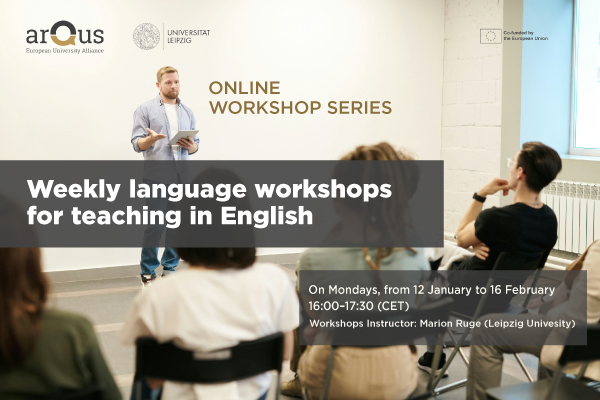
Weekly Language Workshops for Teaching in English

In this series of weekly workshops, language teachers and academics involved in English as a Medium of Instruction (EMI) were invited to boost their own language skills and exchange ideas with international colleagues within the framework of virtual mobility.

In each 90-minute online session, participants have the opportunity to practice various language skills and gather new inspiration for their teaching curriculum. Together, they explore different elements of academic writing, such as cohesive devices and discourse markers, addressing the challenges posed by vocabulary and grammar.

2025 (Ongoing)

#6 Workshop – Reflections and next steps

Monday, 16 February.

This concluding session will provide an opportunity to revisit key themes from the series and address remaining questions or concerns. Participants can share insights, discuss specific challenges and plan how to apply what they have learnt in their own teaching.

#5 Workshop – Teaching presentation skills

Monday, 9 February.

Discover effective ways to help students plan, structure and deliver presentations in English. This workshop will offer language support for guiding students toward academic public speaking.

#4 Workshop – Assessing students’ writing

Monday, 2 February

Gain insight into what constitutes effective academic writing in English and how to recognise it in your students’ work. This session will focus on key criteria such as clarity, structure and appropriate academic style.

#3 Workshop – Giving feedback

Monday, 26 January

Learn how to give clear, supportive, and constructive feedback in English. This workshop will focus on useful language, tone and techniques to encourage student improvement and motivation.

#2 Workshop – Fluency

Monday, 19 January

Explore practical strategies to speak more confidently and naturally in the classroom. This session will help you build fluency, reduce hesitation, and communicate clearly with your students in English.

#1 Workshop – Teaching in English

Monday, 12 January

In this opening workshop, participants exchanged experiences and challenges of teaching through English. They identified common themes and practical approaches for building confidence and effectiveness in EMI contexts.

2024

#6 Interactive skills practice and pronunciation

Monday, 4 March 2024

15:30 – 17:00 (CET)

What is interactive teaching? In this workshop, we will practice ways that student input and teacher responses are best facilitated within the ongoing classroom discourse. The focus of this workshop will be on interactive speaking skills practice.

More information here.

#5 Focus on grammar for teaching in English

Friday, 1 March 2024

13:30 – 15:00 (CET)

This workshop is designed for teachers who want to fine-tune their understanding and use of advanced English grammar in the university classroom.

More information here.

#4 Improve your English fluency

Monday, 29 January 2024

15:30 – 17:00 (CET)

In this workshop, we will produce a short list of language issues that students need for academic success with a focus on interactive communication and refining interactive teacher and peer-feedback in advanced language practice.

More information here.

#3 Vocabulary for teaching in English

Friday, 26 January 2024

13:30 – 15:00 (CET)

University students and lecturers have become increasingly aware of the need to acquire the necessary disciplinary language needed for academic success. In this workshop, we will explore ways to improve lexical choice and range in regard to subject-specific course content.

More information here.

#2 Writing skills for teaching in English

Friday, 19 January 2024

13:30 – 15:00 (CET)

In this workshop, participants will deepen their understanding of specific writing issues that comprise the core of advanced academic English language and content courses. In particular, this workshop will focus on writing and editing practice for assigning and correcting university coursework.

More information here.

#1 Practising cohesion and flow

Friday, 12 January 2024

13:30 – 15:00 (CET)

In academic texts, cohesive devices serve to link ideas and create a logical flow with and between sentences. In this workshop, we will explore the role that cohesive devices play in the creation of academic texts and presentations and practice strategies for teaching these important linguistic elements in the classroom.

More information here.

Newsletter

Don’t miss any news, calls or opportunities from Arqus.
Subscribe now! The future begins today.

    Subscribe


    You can change your mind at any time by clicking the unsubscribe link in the footer of any email you receive from us.

    We use Mailchimp as our marketing platform. By clicking below to subscribe, you acknowledge that your information will be transferred to Mailchimp for processing. Learn more about Mailchimp's privacy practices here.

    Controller: University of Granada (as Coordinator of the Arqus European University Alliance). Legal basis: Arqus is entitled to process your data under the provisions of Article 6.1. (a) of the GDPR: “the data subject has given consent to the processing of his or her personal data for one or more specific purposes”. Purpose: to manage your subscription to mailing lists and to periodically send you the requested information by electronic means. Recipients: Mailchimp. Rights: access, object, rectification, erasure, restriction of processing, data portability. Additional information here.

    Select our profile:

    Apart from the general information, what specific news would you like to receive from Arqus?

    Controller: University of Granada (as Coordinator of the Arqus European University Alliance). Legal basis: Arqus is entitled to process your data under the provisions of Article 6.1. (a) of the GDPR: “the data subject has given consent to the processing of his or her personal data for one or more specific purposes”. Purpose: to manage your subscription to mailing lists and to periodically send you the requested information by electronic means. Recipients: Mailchimp. Rights: access, object, rectification, erasure, restriction of processing, data portability. Additional information here.

    Arqus
    Privacy Overview

    This website uses cookies so that we can provide you with the best user experience possible. Cookie information is stored in your browser and performs functions such as recognising you when you return to our website and helping our team to understand which sections of the website you find most interesting and useful.