A new Arqus Knowledge Pills podcast episode is out: How can we bridge the gap between academic theory and real-world practice?
Arqus
|
13 Apr 2026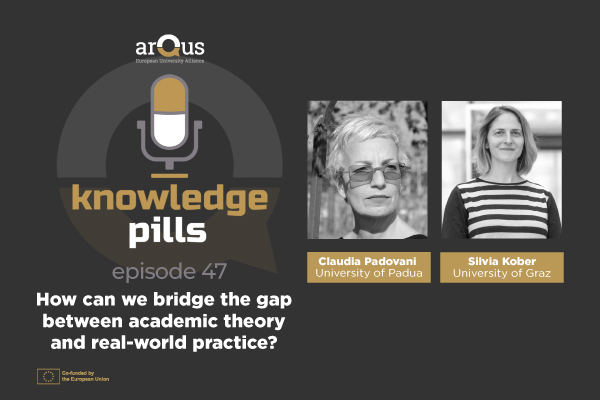
|
13 Apr 2026In an era of rapid technological change and evolving social dynamics, how can university courses prepare students for the ethical and practical challenges of the professional world? What does it mean to “practice” inclusion and care within a classroom setting? These are the central questions explored by Claudia Padovani (University of Padua) and Silvia Kober (University of Graz), winners of the 2025 Arqus Teaching Excellence Award.
As traditional teaching models are challenged, educators must find new ways to engage diverse student bodies through interdisciplinarity, gamification, and hands-on collaboration. This discussion delves into the complexities of “good teaching,” emphasizing the importance of valuing student voices and creating meaningful connections between the classroom and global professional networks.
For the 47th episode of the Arqus podcast, “How can we bridge the gap between academic theory and real-world practice?”, Professor Padovani and Senior Scientist Kober share their unique experiences in transforming the learning environment. They offer a deep dive into how interactive labs and gender-sensitive research can empower students to become active participants in both their education and society.
Associate Professor in Political Science and International Relations at the University of Padua, her work on the global governance of communication focuses on bridging the gap between media policy and social justice, with a particular emphasis on gender equality and communication rights.
Beyond her academic research, she serves as the Director of the Elena Cornaro Center for Gender Studies and is the reference person for the Scholars at Risk network at her university. Nationally and internationally, she co-chairs key working groups within IAMCR and the UNESCO UniTWIN Network, where she is currently exploring the intersections of Gender Justice, AI, and Digital Governance.
Senior Scientist at the University of Graz, she specializes in Neuropsychology and Human-Computer Interaction. With a background as a clinical, health, and emergency psychologist, she heads the neuroscience laboratory “PsyLab,” where she employs advanced neuroscientific methods like EEG and fMRI.
Her research and teaching are dedicated to the development of innovative technological tools for neuropsychological rehabilitation, including virtual reality and brain-computer interfaces (BCI). Known for her “playful” and hands-on pedagogical approach—including the use of “exit-the-lab” games—she strives to provide students with both the practical skills and the critical perspective necessary to navigate the future of neurotechnology.

14 Sep 2026