Arqus Twinning programme on green transition brings Granada students to Vilnius University
Arqus
|
30 Mar 2026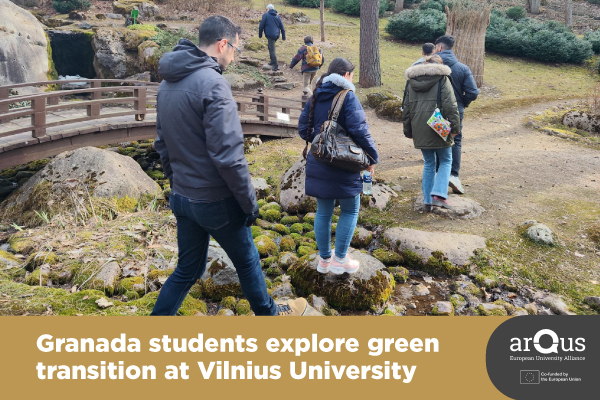
|
30 Mar 2026Five students from the University of Granada – Clara, Diana, Elena, Jose and Adrián – spent a memorable week at Vilnius University as part of the Arqus Twinning 2.0 programme “Urban Green Transition Pathways: Experiences from Vilnius, Granada and Beyond”.
From 23 to 27 March 2026, they took part in an academic visit that brought together sustainability, climate change, urban planning and environmental research. The visit was hosted by Assoc. Prof. Justas Kažys from the Institute of Geosciences.
The programme began at the Institute of Geosciences, where the group was welcomed and introduced to the academic environment that would host many of the week’s activities. From the outset, the visit offered much more than a series of formal meetings. It provided an opportunity to explore how Vilnius addresses major environmental challenges through research, teaching and public engagement, while also creating space for exchange between students, researchers and professionals from different backgrounds.
One of the most insightful parts of the programme was the visit to Vilnius City Municipality, Climate Neutral Vilnius and ID Vilnius. There, the students learned how the city is putting sustainability into practice through climate-neutral initiatives, urban data systems and long-term planning strategies. Seeing how digital tools, environmental indicators and policy decisions come together in the day-to-day management of a city left a strong impression on the group. It gave them an opportunity to move beyond theory and observe how urban green transition is being implemented in practice.
This sense of discovery continued during visits to some of Vilnius University’s most distinctive spaces, including the Museum of Zoology, the Herbarium and the Botanical Garden. These visits opened up discussions on biodiversity, conservation, invasive species and the role of scientific collections in understanding environmental change. For Jose, a biology student, this part of the programme was especially meaningful, offering a closer look at plant conservation and biodiversity management in urban contexts. More broadly, these activities showed that green transition is not only about infrastructure or planning, but also about knowledge, ecosystems and the careful relationship between cities and nature.
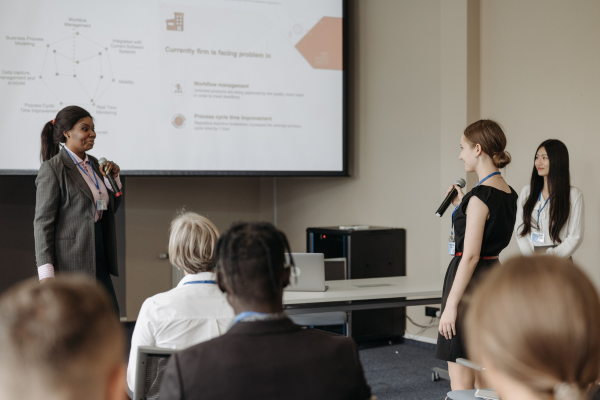
The academic seminars at the Institute of Geosciences added another important dimension to the week. Presentations explored urban landscapes in Lithuania, ecosystem services, green space indicators, remote sensing and climate-related research. The session with PhD students was particularly enriching, as it brought together emerging research from both Vilnius University and the University of Granada. Adrián contributed to the discussion by presenting his work on aerosol and cloud segmentation using lidar-based observations, bringing atmospheric science into the wider conversation on climate and urban environments.
The experience was also closely connected to the students’ individual academic interests. Diana found the programme especially valuable because of its practical and multidisciplinary character, which closely aligned with her academic path and professional interests in environmental planning and sustainability. Clara highlighted the opportunity to compare different approaches to urban management and to reflect on issues such as green spaces, waste and ecosystem fragmentation. Elena was particularly struck by the way technology, environmental awareness and urban strategy were combined in Vilnius, demonstrating how innovation can support a more sustainable future.
Alongside the scheduled visits and seminars, the programme included a lecture on climate change mitigation and adaptation, as well as time to explore the city itself. These moments helped place the academic content in a real urban setting, allowing the students to experience Vilnius not only as visitors, but also as participants in a living example of green transformation. This balance between structured learning and direct experience gave the week a special energy and made the exchange both intellectually stimulating and personally rewarding.
By the end of the visit, the students returned to Granada with more than new knowledge. They left with fresh ideas, stronger academic connections and a shared sense of enthusiasm about the value of international collaboration. Through the experiences of Clara, Diana, Elena, Jose and Adrián, the Arqus Twinning programme once again demonstrated how meaningful such exchanges can be when universities come together to reflect on the future of cities, climate and sustainability from a European perspective.
Article written by Adrián Canella Ortiz (University of Granada)