MICAC students contribute to high-impact research on privacy risks in generative AI platforms
Arqus
|
12 May 2026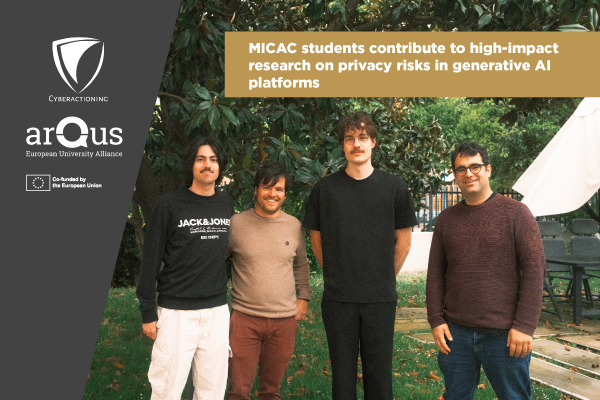
|
12 May 2026Two final-year students from the Arqus Master in International Cybersecurity and Cyberintelligence (MICAC) have contributed to a high-impact research disclosure led by IMDEA Networks, revealing significant privacy risks in some of the most widely used generative AI platforms.
The result highlights the value of MICAC’s international and multidisciplinary model, which connects cybersecurity, cyberintelligence, privacy, law, digital forensics and international cooperation through hands-on research and real-world challenges.
This research, published under the title “LeakyLM – Your AI Assistant Is Leaking Your Conversations”, analyses privacy and tracking practices in major AI assistants, including ChatGPT, Claude, Grok and Perplexity. The study identifies structural risks linked to third-party trackers, exposed conversation URLs, user identifiers, metadata and potentially sensitive information shared during interactions with AI systems.
Among the researchers involved are Tautvydas Jackevičius and Guilherme Oliveira, both final-year students of the Master in International Cybersecurity and Cyberintelligence (MICAC). They are currently developing their Master’s theses at IMDEA Networks, one of the associated partners within the Cyberactioning project ecosystem.
Their participation is a strong example of how MICAC connects advanced academic training with real research environments and emerging cybersecurity challenges. Through their thesis work, students are not only completing the final stage of the programme, but also contributing to research with direct societal relevance in areas such as privacy, artificial intelligence, digital security and cyberintelligence.
MICAC is an international joint master’s programme delivered by four Arqus universities: the University of Granada, the University of Padua, Vilnius University and the University of Minho. Its structure combines technical, strategic, legal and international perspectives, offering students a multidisciplinary approach to cybersecurity and cyberintelligence across different European academic and research environments.
The findings have already attracted significant media attention in Spain, including coverage in El País, elDiario.es and El Periódico, underlining the public importance of the research and the urgent need for transparency, accountability and robust privacy safeguards in generative AI services.
This achievement highlights the value of the MICAC model: an international, research-oriented joint master’s programme where students engage with real-world cybersecurity problems in collaboration with leading universities, research centres and associated partners.
Congratulations to Tautvydas, Guilherme and the entire IMDEA Networks research team, specially to Dr. Narseo Vallina-Rodríguez and Dr. Guillermo Suárez-Tangil for this outstanding result and its remarkable impact!