New Twinning and BIP programmes strengthen mobility within Arqus
Arqus
|
20 Apr 2026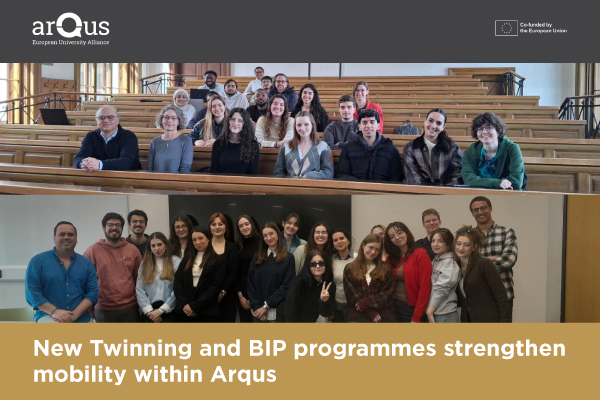
|
20 Apr 2026Students and staff from the University of Minho have recently taken part in two short-term international mobility initiatives within Arqus, reinforcing collaboration and innovative learning across partner universities.
These activities, held in March, brought together participants from University of Graz and Maynooth University through two complementary formats: a Twinning programme and a Blended Intensive Programme (BIP). Both initiatives reflect Arqus’ commitment to fostering mobility, interdisciplinary education, and closer academic cooperation among its members.
The Twinning programme, hosted in Graz from 23 to 27 March, focused on the theme “Greening Transitions with AI, Climate, Employment, and Sustainability in Action.” Through lectures, collaborative work, and joint academic activities, students and staff explored the intersections between digital innovation and sustainability, while strengthening academic and intercultural exchange. This initiative also built on previous mobility activities, including an earlier visit of Austrian students to Minho, highlighting the reciprocal nature of Arqus mobility schemes.
In parallel, a Blended Intensive Programme took place at Maynooth University from 24 to 30 March under the theme “Religion & Politics: International Contrasts.” Combining in-person sessions with collaborative learning components, the programme encouraged participants to engage in comparative analysis of political and religious dynamics across different global contexts.
Twinning and BIP programmes are key instruments within Arqus mobility actions. While Twinning initiatives promote reciprocal short-term exchanges between partner universities, fostering joint teaching and learning experiences, BIPs – supported by Erasmus+ – combine physical mobility with virtual collaboration to create flexible and innovative international learning environments.
Beyond their academic content, both programmes offered participants the opportunity to develop transversal skills, including intercultural communication, teamwork and critical thinking in international settings. These experiences contribute to preparing students and staff to address complex global challenges through collaborative and interdisciplinary approaches.