The first MICAC cohort celebrates graduation at the University of Minho
Arqus
|
13 Jul 2026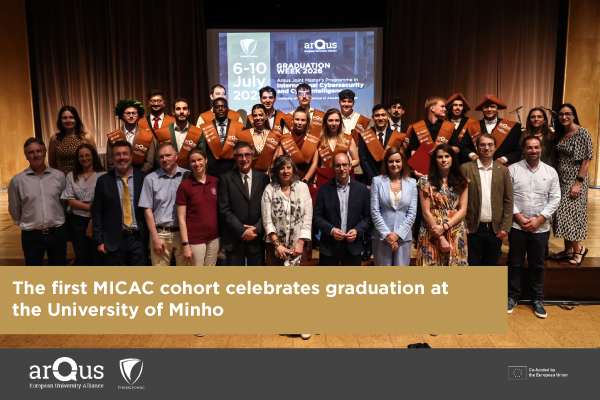
|
13 Jul 2026The Arqus Joint Master’s Programme in International Cybersecurity and Cyberintelligence (MICAC) reached a historic milestone on 10 July 2026 with the celebration of its first Graduation Ceremony, hosted by the School of Engineering of the University of Minho, in Guimarães, Portugal.
The ceremony marked the culmination of the first MICAC Graduation Week, during which students successfully completed the final academic requirements of the programme, including the Attack & Defence Exercise and the public defence of their Master’s dissertations. Throughout the week, representatives from the four partner universities also held coordination meetings to evaluate the first edition of the programme, exchange experiences and discuss future improvements for the next cohorts.
The Graduation Ceremony brought together students, their families and guests, academic staff and institutional representatives from across the consortium to celebrate the achievements of the first graduating cohort of the programme. The event was opened by Professor Joana Cunha, Vice-President of the School of Engineering of the University of Minho, who welcomed participants and highlighted the importance of international cooperation in higher education.
The ceremony continued with an open lecture delivered by Professor Henrique Santos, entitled “Cybersecurity and Cyberintelligence: Educating for an Uncertain Digital Future”. His presentation reflected on the challenges of educating future cybersecurity professionals and the role that international joint programmes such as MICAC play in preparing graduates for an increasingly complex digital landscape.
One of the highlights of the ceremony was the students testimonials, in which three representatives of the graduating cohort –Shashank Mishra, Juan Manuel De Santa Olalla Gómez and Raphael Alexandre Toubol– shared reflections on two years of academic challenges, international mobility, cultural exchange and personal growth across four European universities.
The audience also heard from Professor Gabriel Maciá Fernández, Vice-Rector for Digital Transformation at the University of Granada and one of the academic coordinators of MICAC, who reflected on the creation of the programme, the value of European cooperation and the importance of educating highly qualified professionals capable of responding to the cybersecurity challenges facing Europe.
The ceremony then continued with the presentation of commemorative certificates and the official MICAC graduation sashes, specially designed by the Arqus Alliance as a shared symbol of the programme and the successful completion of this international educational journey.
The event concluded with closing remarks by Professor Cristina Dias, Vice-Rector for Education and Academic Organisation of the University of Minho, followed by a group photograph bringing together graduates, academic staff and institutional representatives to commemorate this historic occasion.
The ceremony also reflected the strong institutional commitment of the four partner universities. Representatives from Vilnius University, including Professor Linas Bukauskas and Professor Agnė Brilingaitė, from the University of Padua, including Professor Davide Bresolin, Eleonora Losiouk and Professor Nicola Laurenti, and from the University of Granada, including Professor Antonio Mora, were also present.
As the first cohort graduates, MICAC enters a new stage of maturity. The experience gathered during these first two years will continue to strengthen the programme and support future editions, reinforcing the commitment of the Arqus Alliance to delivering innovative, international and interdisciplinary education in cybersecurity and cyberintelligence.
The Graduation Ceremony also marked an important milestone for the Cyberactioning Project, co-funded by the Digital Europe Programme, demonstrating how European cooperation can successfully contribute to educating the next generation of cybersecurity professionals while strengthening collaboration between European universities.


09 Jul 2026