Beyond the lab: How one PhD exchange sparked a long-term research collaboration
Arqus
|
23 Apr 2026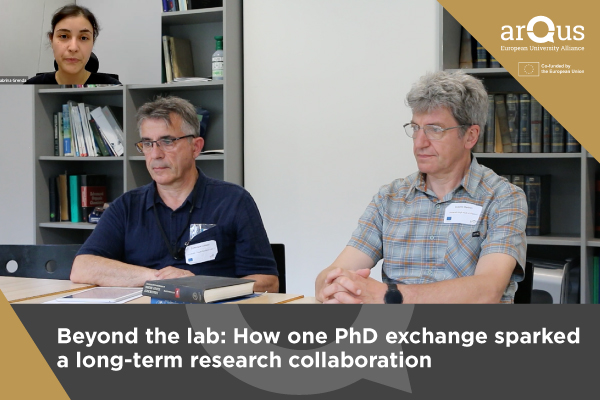
|
23 Apr 2026What happens when you bridge the gap between two labs in Lyon and Padua? In the case of Dominique Luneau, Antonio Barbon, and Sabrina Grenda, a simple research stay blossomed into a prestigious publication, a Marie Curie network, a BIP and a thriving community of scientists across Europe.
The Arqus Alliance is built on the belief that when we connect researchers, we don’t just share equipment—we spark innovation. The video interview with Dominique Luneau (Professor of Inorganic Chemistry at Lyon 1 University), Antonio Barbon (Associate Professor in the Department of Chemical Sciences at the University of Padua), and Dr. Sabrina Grenda (at the time PhD student at Lyon 1 University) offers insight into how simple Arqus connections can act as catalysts for long-term academic excellence.
The journey began when prof. Luneau encouraged Sabrina to seek out specialized Electron Paramagnetic Resonance (EPR) spectroscopy techniques for her doctoral thesis on the magnetic properties of molecular materials. This search led her to the University of Padua and the lab of prof. Barbon.What started as a practical need to access advanced characterization methods quickly evolved into a deeper synergy that culminated in the development of new pulse EPR methodologies and a high-impact publication in the Journal of the American Chemical Society (JACS)—one of the most prestigious milestones in a chemist’s career.
For Sabrina, the impact was life-changing. This Arqus-facilitated mobility was her first research experience abroad, providing the professional confidence and international pedigree that eventually led her to a postdoctoral position at Sungkyunkwan University in South Korea. In 2026, she was awarded the French National Thesis Prize by the Association Française de Cristallographie, further recognising the excellence of her doctoral work.
But perhaps the most impressive part of this story is how it didn’t end when the thesis was finished. The collaboration built between the two professors acted as a catalyst for a much wider network.
This trajectory proves that a single bridge built between two professors—a simple agreement to share a lab bench—can evolve into joint funding, shared training programs, and a lifelong professional community and eventually carry an entire community of scholars toward a more integrated, innovative European Research Area.
Watch the full interview to see how these researchers turned a lab visit into a lasting legacy: